
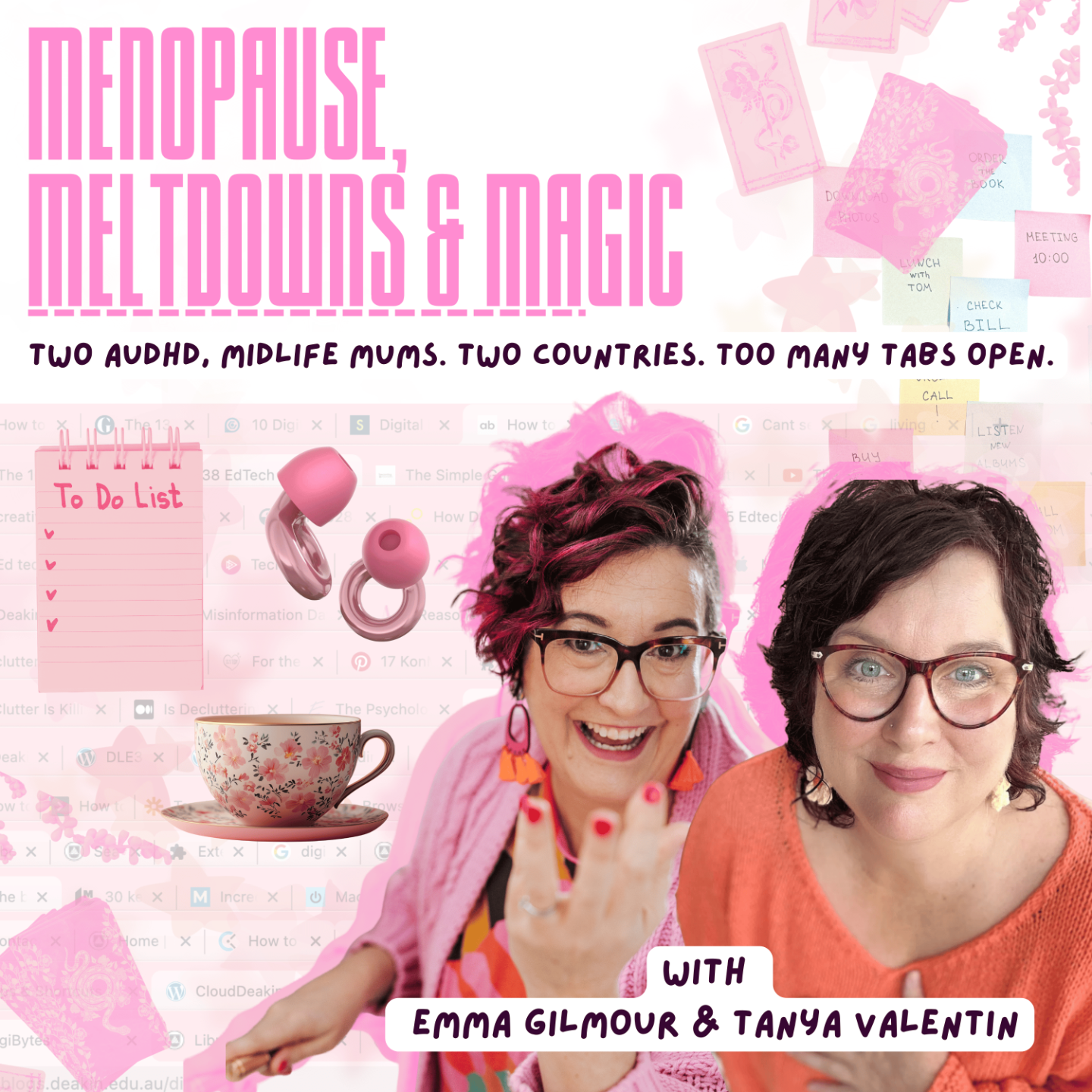
EPISODE 1
Meet Emma and Tanya
Welcome to Menopause, Meltdowns and Magic.
In this first episode, Emma Gilmour and Tanya Valentin introduce themselves and share what this podcast is really about — the conversations we’re having, the stories we’re telling, and what you can expect from this space.
If you are a midlife mother raising a neurodivergent child, there’s a strong chance you’ll feel right at home here.
Summary
Trailer Summary
Menopause, Meltdowns and Magic – Introduction
In this very first episode, Emma and Tanya introduce themselves and share the personal and professional journeys that brought them together. Tanya speaks about her work as a neuro-affirming family coach, her background in education, and her lived experience as a late-diagnosed ADHD mum raising neurodivergent children — including navigating severe burnout with her daughter. Emma shares her transition from corporate marketing into counselling and psychotherapy, her work supporting women in midlife, her sobriety journey, and discovering her own neurodivergence later in life.
Together, they explore why there’s no one-size-fits-all framework for parenting or personal growth, especially in neurodivergent families. They discuss emotional coaching, menopause and perimenopause, identity shifts, and the deep transformation that can come through life’s hardest seasons. While acknowledging the very real challenges of parenting and midlife, they also introduce the “magic” — the connection, humour, perspective shifts, and unexpected growth that can emerge along the way. This episode sets the tone for honest, compassionate conversations about navigating menopause, meltdowns, and everything in between — with depth, lightness, and real lived experience.


Transcript
Tanya:
Hello everybody, and welcome to Menopause, Meltdowns and Magic. You’re here with Emma Gilmore and myself, Tanya Valentin. This is our very first episode — our introduction to you and a chance for you to get to know us a little better.
Emma:
Thanks, Tanya, for kicking us off. Should we start with a bit of an introduction to ourselves?
Tanya:
Yes, absolutely.
For those of you who don’t know me, I’m Tanya Valentin. I’m an ADHD mum of three neurodivergent children, and I work as a neuro-affirming family coach. I live in New Zealand and have a background of 25 years in education.
I’ve worked as a professional development facilitator and tertiary educator, teaching beginning teachers about human development. I also studied formal parent coaching through the Tuning Into Kids program at the University of Melbourne.
I combine all of my professional knowledge with my lived experience as a late-diagnosed neurodivergent person and a mum to neurodivergent, PDA, autistic and ADHD children — including a daughter who experienced severe burnout.
I use evidence-based parenting strategies alongside lived experience to support parents in navigating their own journeys.
Emma:
That’s such a beautiful introduction. And do you know what’s interesting? I also studied Tuning Into Teens when I first changed careers. Isn’t that funny that we have that in common?
Tanya:
It is! I remember doing the course as a parent and being blown away by what I learned. I just knew I wanted to use it to help other people, so I went on to do the training.
It’s based on emotional coaching principles from John Gottman. Essentially, it’s about helping children feel their emotions, validating them, and learning to sit with emotions instead of immediately trying to fix or problem-solve.
One of the biggest things I learned was about meta-emotions — our feelings about feelings. It was incredibly confronting and transformative.
Where I’ve had to adapt it in my work is around neurodivergent children. Not all children want to label or talk about emotions. For some, especially PDA children, that can feel overwhelming or shutting down. So I’ve adapted the framework using neuroscience and lived experience to better support families.
Emma:
I relate to that so much. It’s like with everything we study — we take what resonates, then ask: how does this work for people who struggle with interoception or identifying emotions?
A bit about me: I worked in corporate marketing for most of my career. In 2018, I left and retrained as a counsellor and psychotherapist. During that time, I also stopped drinking using the This Naked Mind method and trained as an alcohol coach.
I now work primarily with women in midlife — which makes sense, because I’m a woman in midlife myself. At the time, I didn’t realise I was neurodivergent. But as I stopped drinking, it felt like layers of masking slowly came off. I began recognising neurodivergence in my children, my youngest experienced burnout, and I discovered my own neurodivergence too.
Even now, as I finish training in intuitive eating, I see how many frameworks assume strong interoceptive awareness — something many neurodivergent people struggle with. So again, it’s about adapting what we learn to make it helpful, not harmful.
Tanya:
Yes. I often say to parents: there’s no single framework that works for everyone. That’s not just a neurodivergent thing — that’s a human thing.
I encourage people to imagine building their own toolkit. You go to one store and pick up a hammer. Somewhere else, you find another useful tool. Over time, you build the toolkit that works for you — rather than buying a full set and discovering half of it doesn’t fit your family.
Emma:
Exactly. And I think that’s part of the fun — finding the bits that resonate and weaving them into your own approach.
Tanya:
One thing I love about having a neurodivergent brain is seeing patterns and connections. Throughout my career, I’ve taken ideas from completely different fields and brought them together.
For example, I love the work of Dr. Emmi Pikler, a Hungarian paediatrician. Her philosophy around infant care and respectful relationships has influenced how I think about all relationships — not just with babies.
Being able to see those patterns and apply them in meaningful ways feels magical to me.
Emma:
Tanya and I met and really enjoyed talking to each other. We thought, “This is fun — maybe other people would find it useful too.”
This podcast is for women — and anyone who wants to listen — navigating menopause, neurodivergence, parenting, identity shifts, and all the messy, beautiful bits in between.
And we love the name we came up with…
Tanya:
Menopause, Meltdowns and Magic.
You can expect honest conversations about menopause and perimenopause — what’s happening in our bodies as women and as parents — alongside the neurodivergent aspect, both in ourselves and in our children.
And then there’s the magic.
For me, the magic is about connection. Even when things feel incredibly hard — and they are hard — there are still sparkles. There are lessons. There are moments of beauty.
Emma:
Yes — the sparkles. The synchronicities. The brain-tickling moments where you realise everything is connected.
We also hope to bring some humour. Sometimes neurodivergent parenting can feel heavy. But it’s not all doom and gloom. Yes, there are challenges — but there’s also gratitude, delight, transformation.
Tanya:
One of the biggest mindset shifts for me has been moving from “life is happening to me” to “life is happening for me.”
That doesn’t mean bypassing the hard. It’s both/and. We can acknowledge the pain and also ask, “What is this teaching me?”
A quote that carried me through my daughter’s burnout comes from Joseph Campbell:
“The cave you fear to enter holds the treasure you seek.”
Looking back, I don’t think I would undo the perspective and growth that came from those dark times — even though I would never minimise how hard they were.
Emma:
Yes. And when you’re in it, the last thing you want to hear is, “It’s all a lesson.” I know I didn’t!
But looking back, almost everything I’ve resisted has shaped me in ways I needed.
Our children have been profound teachers. They’ve made us question identity, gender, parenting, trauma, spirituality, career — everything.
And the learning never stops.
Promotions
Upcoming events and Course will be posted here.

Want a text when we go live on Instagram?
Drop your details below and we’ll send you the direct link so you can join us, ask questions and be part of the conversation in real time.
Opt out anytime.
YES! SIGN ME UP