
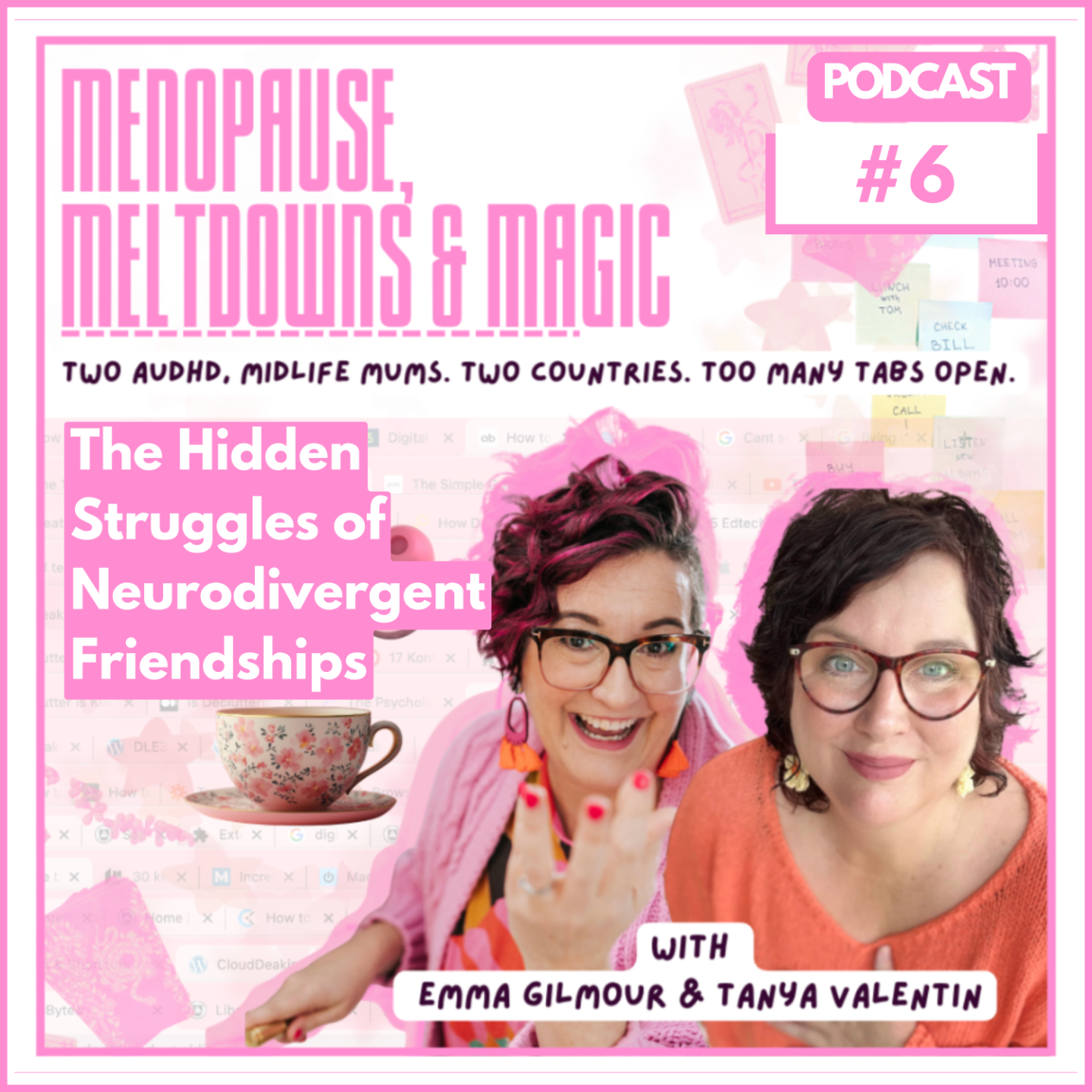
EPISODE 6
The Hidden Struggles of Neurodivergent Friendships
Friendship can feel complicated, especially for neurodivergent women navigating masking, burnout, grief, and identity shifts.
In this deeply honest conversation, we explore how our experiences of friendship have been shaped over time—from early moments of exclusion and heartbreak, to high-masking personas, to the quiet unravelling that often comes with burnout, sobriety, or late diagnosis.
LISTEN NOWShow Notes
Episode 6
Friendship can feel complicated, especially for neurodivergent women navigating masking, burnout, grief, and identity shifts.
In this deeply honest conversation, we explore how our experiences of friendship have been shaped over time—from early moments of exclusion and heartbreak, to high-masking personas, to the quiet unravelling that often comes with burnout, sobriety, or late diagnosis.
We talk about what happens when your world becomes smaller, when your capacity changes, and when the people around you don’t quite meet you where you are. And we gently name the grief that lives underneath it all—the friendships that didn’t hold, the community that didn’t show up, and the longing to be truly seen.
This episode is a soft place to land if you’ve ever felt like you don’t quite “fit” in friendship, or if connection has felt confusing, one-sided, or out of reach.
You are not alone in this.
In this episode, we explore:
- Why friendships can feel especially complex for neurodivergent women
- How early friendship experiences can shape masking and identity
- The impact of high masking and performing “acceptability” in relationships
- Friendship breakups and the deep, often unspoken grief they carry
- How alcohol, achievement, or caregiving roles can become forms of masking
- The shift that happens when masking drops (through burnout, diagnosis, or sobriety)
- Why some friendships feel “hollow” or difficult to sustain over time
- The emotional labour of being the one who maintains connection
- The experience of “disappearing” from friendships during burnout or crisis
- Why many neurodivergent people prefer depth over small talk
- Object permanence and “out of sight, out of mind” in friendships
- The difference between neurotypical and neurodivergent social expectations
- How parenting a child in burnout or crisis can reshape your identity and relationships
- The loneliness of experiences that others don’t understand (e.g. mental health crises vs. physical illness)
- The role of cultural narratives like “just world theory” in how people respond to hardship
- Grief as a central, often missing piece in friendship and community
- The importance of being witnessed, rather than fixed or judged
- What it feels like to find safe, attuned connection with other neurodivergent people
A gentle reflection:Where have you felt like you had to “perform” in order to belong?
What kind of friendship feels safe and sustainable for you now—not who you used to be, but who you are today?
You are welcome to share your lived experience of this in the comments.
Podcast: Meltdowns, Menopause and Magic
Hosts: Tanya Valentin & Emma Gilmour
If you are a parent of a child or teen in burnout needing support, join Tanya's Parent Community: From Burnout to Balance
Wherever you are in your relationship with alcohol, this is your next step. One FREE hour. One conversation. Five shifts. Your 'take it or leave it' relationship with alcohol starts here: FREE Masterclass


Transcript
Tanya (00:00.142)
share this with those that can't make it. Yeah, so today we're going to talk a little bit about monotropism. I don't know if any of you know much about about monotropism or how it works. I know I put a little course out there, but I know not everybody, you know, is able to has the capacity to engage with that and access that. So we're just going to talk a little bit more about that today.
and also an opportunity for you to ask about ask some questions about what this might look like for you a child in different ways and yeah to just sort of apply this understanding in real life rather than from a theoretical point of view. So let's just start by just just arriving here today just taking a moment to just
ground ourselves. I know Jackie you're still in bed but I know some of us have been rushing around already, day's been quite busy so just take a moment to just feel your feet whether they're still in bed nice and cozy and toasty or they're down on the floor if you're sitting, just focus in on
your toes, the soles of your feet.
Tanya (01:37.258)
and the seat beneath you, whatever's supporting you, just feel the support of that.
And then just take a moment to just notice your breath.
and we're not doing anything to change the way that we're breathing, we're just noticing the in-breath
the out-breath.
Tanya (02:08.398)
You may just even just put a hand on your heart if that feels good for you and just remind yourself that you are safe in this moment and that you are supported by the surface whatever's holding you in this moment and also in this community and
If it feels comfortable just gently reopening your eyes and then just welcoming ourselves into the space.
Tanya (02:46.346)
So, monotropism is a theory of focus and attention that was created or proposed by autistic educators and advocates maybe about 30 years ago. I know that it started with Dr. Murray and her son
has continued that work now into the present time. And what I like about the theory of monotropism is that a lot of times, especially autistic humans, are pathologized, know, like, they've just got tunnel vision, they've just got a one track mind, why can't they just, you know, switch focus and move to this next thing?
Um, and it can sometimes be portrayed as a really bad thing. And it does have its challenges having a monotropic brain, but there are also some really amazing positives to it. And as parents and people who care for autistic people, or maybe have, you know, a spouse that's autistic, or maybe even
ourselves who are autistic and a lot of ADHDers also have monotropic brains. Understanding how this works can be incredibly helpful for us to support our children because when we don't understand this type of attention we can put extra demands on our children on their nervous system.
without even realising that we're doing it.
Tanya (04:47.174)
And then often, you know, our children are, you know, sometimes punished or disciplined because they, you know, they haven't heard or they can't learn or they can't focus when actually they are focusing, but the focus might just be on something else. So it has implications when it comes to things like
burnout and how our children got into burnout in the first place. It has implications when it comes to what we sometimes see as behavior. It also has some implications around like recovery and what our children might need in recovery. And then there's also the aspect of
Tanya (05:41.976)
Sometimes this can play into things like thought loops and thoughts and things that can be unhelpful to our children, that can be distressing for them. we can find it sometimes really hard to shift them from those thought loops and from their thinking.
Tanya (06:06.764)
So at its core monotropism means that the focus of the person is more sort of like singular or focusing on very small amounts of like attention points at one time and the attention channels are a lot deeper.
as opposed to people who have more of a monotropic, a polytropic brain where they're able to focus on lots of different things and receive lots of different inputs of information and communication at one time and not feel overwhelmed by it. And for people with a polytropic brain, they have more tolerance to these multiple channels of focus and attention.
And also they're not as deep, so you're able to have more flexibility between, like shifting between focuses.
For a person with a monotropic brain, once they're in that sort of deep attention channel, it can feel quite destabilizing when they're pulled out of it before they're ready. And it can also...
you know, be like when they're in that channel of focus, it can be really hard for them to notice what's going on around them. It can be really hard for them to notice what's happening inside of them through like interoception and signals from the body. And it can also feel, you know, like anything that sometimes is outside of that.
Tanya (08:02.904)
that deep attention channel can sometimes just fall off the edge and you just kind of forget about it as if it never happened.
And then the other part of this is the monotropic split. So this is, we often see this, know, say for example, we see this in a parenting context, our child is like really focused in on something that they're enjoying, perhaps like a video game or like watching YouTube or even if it's like a creative thing. And
then they're really focused in there. We come in and we say, hey, you need to put that down now and you need to like switch to this thing. You need to come eat or you need to brush your teeth or you know, whatever it is. And what happens is the first thing that we often see with our children when we're pulled out of that deep focus is there's dysregulation. There's
meltdowns, there's often rage because the focus that they've been engaged in has been incredibly safe, predictable, enjoyable, regulating, they may have in their mind like I need to, like I have to reach this point in the game.
before I can stop. have to finish reading this chapter. I have to get to this place in whatever it is that I'm doing. And so it doesn't feel finished for them when they're pulled out of it.
Tanya (09:53.626)
And because that channel of focus is so deep, when they're pulled out of it to go do something else, their brain is still actually still focusing on the task, or the thing that they were focused there where their attention was first. So now we're asking them to do something else.
but their attention's still in that monotropic channel. And so there's the split, often, you know, which puts a lot of stress on our children's resources, on their nervous systems, because their brain is not wired to work that way.
Now doesn't mean that our children can't be supported to move from one thing to the other, but a lot of times when we don't understand this, we just pull children out of it. We expect them to just switch transition to the next thing and to give the next thing their full attention. And then when they struggle, when they're dysregulated, we see it as behavior rather than a function of their attention and their brain.
In a school context where there are lots of different transitions and changes, this is particularly problematic because our children might be like given a task, especially if you perhaps have ADHD as well and you like it takes a bit of time for you to actually achieve that flow state. You're in it, you're
you're getting the work done, you're concentrating, you're getting into a bit of a flow and then they say, okay, put your books down, we're moving on to this next thing or change the topic or like in high schools and things like that often, you know, you have to like, we have to move from class to class. Like you're constantly getting that split, you're constantly getting that interruption of flow. And over time,
Tanya (12:09.282)
you're using a lot of your internal resources through that shift, through those transitions. And that can be really, really hard. The other thing with monotropic attention is sometimes it's not on the learning, sometimes it's not on the enjoyable thing, sometimes it's on the attentions on like
how much noise is in the room, how much light, how many people, the discomfort, I'm wearing this jumper and it's a bit scratchy, or there's a smell in the room and I can't get past it. So all the attention is focused on that discomfort or that sensory thing. And then it's really difficult for them to be able to focus on the learning.
And that's why things like noise cancelling headphones, different sensory aids in the classroom is helpful because the attention is more on the learning and what our children are expected to do and it's not constantly being pulled away to all the sensory stuff around. I've done a lot of talking and I just wanted to know
Does this track with your children or people in your family? And are there any questions?
Tanya (13:57.006)
This is very thorough, thank you. Because I've heard a lot about monotropism in general, and I have a general idea, but at this depth, it's very interesting. And my 15-year-old is being pre-assessed, because I think he has ADHD, like a week from today. Because I'm finding my mind, I think he has a monotropic way of thinking. Yeah, he talks about.
What does he add? Doesn't matter. But like he has a word for he locks in. He's like, I got locked in. And I remember when he was little, like really little, he would have a hard time switching gears. So we would always say in five minutes we're going to whatever. And that seemed to help a lot now. So yeah, that really, really, I'm finding myself thinking more of that. The older kid who's not in burnout and then my child who is in burnout. Like I know this is true of him. Like I see him.
In flow state, it's and you know, the video games and all like he gets in like dialogues around his special focus, interest things. I don't the struggle with transitions. It's like, I'm wondering if he's been internalizing that or I don't know. I haven't seen it as much with him. So anyway, it's just interesting like how I think they do both have monotropic ways of thinking, but it should, it looks different on the outside.
Yeah. And you know, that just really shows the differences and experiences, right? And, you know, different kids are going to need different supports, or different things to help them to be able to, you know, to shift to to manage this. And it's not going to look the same for everybody. Yeah.
Yeah, like I know I, I experienced this a lot in my own life. just through myself, like, it takes a lot for me to actually get down and focus. And then when I'm focused, I, and somebody comes and interrupts me to do something silly, or my husband comes in to ask me a question. What he often gets is rage, because I'm just like, you don't know how
Tanya (16:24.27)
how much effort has actually gone into me being able to focus on this. And now that I'm finally focusing on it, coming out of it's really hard for me. And the other way that can sometimes also show up for our kids is once they're locked in, and you might see this more with your older son, is that sometimes self-care falls off the edge.
They don't get hunger cues, don't go to the bathroom, they don't drink water. Yeah, and I know that that is true for me. Like if I sit down and I work, I've got to make sure that I have breakfast beforehand because it could be like, I could start sort of working at my computer at like eight o'clock in the morning and then it's three o'clock and I haven't had a single thing to eat. I haven't had a bathroom break because my brain has just become so focused on the thing.
that forgets that it has a body. And for our children, that can be really, really hard too, because, you know, if they have like, we, even though we're not focusing on our body, our body still has needs, right? And, absolutely. And they're not going to go away just because we don't focus on them. So,
That can be another thing, I think, especially for a lot of people with ADHD, that can be quite a big thing for them and a barrier to them being able to take care of themselves and their wellbeing. Yeah. I don't know if you've noticed that particularly with your older son, does he? He can, yeah. Yeah, sometimes I'll be like, have you had protein? If he doesn't get his protein, he's like very grumpy and often, yeah, he'll forget.
And my husband also will forget to drink water because he'll get to the point, he's gotten to point of dehydration. like, like he had to go to the hospital. Like, thankfully that has only happened once. But yeah, it's good to understand why. Yeah. Now we have conversations in our family a lot, like, are you drinking water and things like that? Yeah. Yeah. Because when it gets to the level of going to the hospital as a wife and like,
Tanya (18:47.182)
We're going to work on this. Yeah, yeah, absolutely. He's like, yes, you can remind me. Yeah. I want him to drink. So absolutely relate to that. And I think it's important to realize that, to recognize that so that we know how to support the people around us. And sometimes it's about just as simple as putting like, if you are around, putting a glass of water next to him so that he's like, OK, yeah.
I drink that. I know for myself, I'll often make sure that I have a full water bottle on my desk, because then it's easy for me to just grab that while I'm working and I don't have to get up and change focus. So it's just about being mindful about these things and also having people who can support you, but also if you have the capacity.
working out ways that you can support yourself too. So that your self care doesn't fall off the edge. know, maybe having like snacks in a drawer or, you know, things like that. So we found snacks in my son's drawer the past two days. The one who's being assessed for ADHD. I wonder if that's why he does it. Anyway, when you said snacks in the drawer, I'm like, my gosh, just today my husband pulled out chocolate chips from his drawer.
Huh? Yeah. And it can also just be, you know, that sometimes when you are using your, like the snacks tend to be like high, high dopamine or like, you know, high sugar or things that have a lot of energy. And, know, when you're using your brain a lot, your, your body starts to crave things like sugar and energy.
keep that going. sometimes the snacks might look like junk food but actually there is a reason why your body's craving those types of snacks. Cool thank you good timing. Awesome I'll see what you've written here Jackie. Pass have said have not have said I noticed this Bella but since being in burnout it's very obvious.
Tanya (21:05.166)
Like she could mask that before and cope. Now she can't. At last year, it was very obvious, once she started to study, she could go hours with no drinking, eating, toilet. Need to remind her. And once she stopped, she would completely crash in exhaustion. Absolutely. And the other thing that can sometimes happen, and I have seen this a lot with people with ADHD in particular.
is that when you're locked into a like a hyper like a special interest or a hyper focus it becomes the thing that like your brain is focused on for like
weeks and you know like you just like every single second you're wanting to be engaged in that thing that you forget to you forget to take care of yourself and then when that hyper focus ends it can feel like you can get these feelings of emptiness of sadness of grief
Because the thing that you were enjoying, or the thing that like you were in flow with or was taking all your time and energy, it's now gone. It's kind of like it just sort of like, sometimes it's like a project that you've been focusing on. But sometimes it can just be, you know, you have this idea of something that you're like creating or, you know, focusing on and then the hyper focus can just kind of disappear like, like poof. And then you're like,
Whoa, where's this thing? then so you have that emotional crash, which can often happen to a lot of children. But you also have to play catch up with your self care. Because during that time, you haven't been taking very good care of yourself. So that's also something to be mindful for, especially I think in particular with people with ADHD struggle a lot with that.
Tanya (23:15.266)
So if you're noticing an emotional crash after hyperfocus, that can often be why.
Tanya (23:30.426)
For our children in burnout, and for recovery, what is quite important for us to remember is that every transition has a cost. It has a nervous system cost. It has a resource cost. So this is one of the reasons why it's so important for us to like
do an inventory of transitions and are those transitions necessary?
Or are they just, you know, we do things sometimes just for the sake of, we've always done it that way. And so we don't even think to question it.
Tanya (24:29.592)
So that is the one thing that's important for us to look at in terms of demands. The second thing is to, if your child does hyper-focus to the extent of their basic needs are not met, what are some things we can do to strew things in the environment?
can we bring some food and just put it next to them or make sure that they have water or liquids or fluid nearby. Some people, some children respond well to things like if you put like physical sort of like things like trampolines or wobble boards or things in the environment where they're busy with
hyper focus they can they sometimes will use that if it's in the environment but being pulled away to go do something active or physical you know has a lot of load and also just like well what are the ways that we can help our children to transition to shift from one thing to another
So I noticed, Dana, you said, you like you would often give your son like little time warnings and he's quite, he's okay with that as a way to help him to transition. Yeah. Yeah. We don't do that. But when he was little, it helped a lot. good. Yeah. Sometimes it's just recognizing that
their transitions hard and just sitting in the room with their child while they finish whatever it is that they need to do so that they can have some co regulation when they move from the one thing to the other. And sometimes it's just recognizing that it's going to be hard and that there might be a meltdown doesn't mean that we shouldn't like. We shouldn't shift them. It just means that we hold.
Tanya (26:50.498)
the transition in a realistic frame of mind. We don't have the go in it with the goal of like, I'm going to have the perfect script, the perfect way of doing this, that it's going to equal no distress. Because this is just where my child's nervous system is at the moment. And instead of like, I'm going to stop this regulation.
like how can I hold them through this dysregulation and make it easier for them by having having support? How can they be supported through this transition?
Tanya (27:34.264)
So I don't know, with Jackie and Tina, what are transitions like for your children when they're moving from one thing to the next?
I noticed a lot in burnout. think, as I said before, think in past, I think Bella found those things really difficult, but she was able to mask it. So she was so hell bent on doing the right thing because she's such a people pleaser that she would do it. But what I noticed now is that, and interesting her, like I I've described it up until now as I can
see her nervous system physically react. So if I go into her room,
you know, let's say at 5.36 o'clock and she's sitting in her, like she's doing something, she's on her phone and she's read, particularly I notice it when she's reading. So she might be in the middle of a book or whatever she's doing. If I then say, walk in and go, hey honey, like let's talk about dinner. I can get a response, which is she actually almost starts shaking.
And she goes, can't just don't, don't, don't talk to me. Don't talk to me. Can you come back? Can you come back? you come back? And it's a real reaction to, I can't take in that what you're asking me right now. And if I push, it just gets worse and worse. So now what I do is as soon as I see those signs, I go, it's fine. Why don't you just process that in the background for a little bit. And then I'll come back in 10 or 15 minutes. And then usually by the time I've come back.
Tanya (29:21.844)
she then can click out of it enough to have a conversation with me. Yeah. And that's a great example. Thanks for sharing, Jackie. Sometimes our children need their time to process, right? Like the process of speed is also a bit laggy. And then they need a bit of time for us to kind of give them the information.
Time to process it and then to be able to respond to us.
And I think that's the thing, was like, since she's sort of been in this really bad burnout, it's almost like she can't, she can't mask by doing the polite thing. Like she knows that it's not, like I think she, and in the past, like when we didn't know she was autistic, there's no doubt that I would have said, well, you have to decide now. We have to have this conversation. Or I might have gotten, if she responded by being angry,
I would have probably the message that she would have received was that she was doing the wrong thing. Don't talk, you know, when I might've said, don't talk to me like that, or come on, I'm just asking you a simple question or do you know what mean? Like that, that demand of, of pushing through. So I think that's where a lot of the mask came from and the same at school. She knew she had to do these things. So she just forced herself. Yeah.
until she couldn't anymore. Yeah. And you know, there are a lot of times when we see that dysregulation, we see it as a sign of rudeness, we see it as sign of noncompliance or misbehaviour rather than, this child needs a little bit of extra time to process information or to be able to switch gears or switch focus from one thing to another, Yeah.
Tanya (31:24.374)
And I think as a little child, use a bit like what Dana said, we use a lot of that. Bella always like the routine at night was always before she went to bed, we would talk about the next day. So tomorrow this is happening, that's happening. This is the way this is going to be. This is who's picking you up. What this is the time something's happening. And I did a lot of that, but then as she got older and into her teen years, I guess you kind of expect they don't need that anymore. So you drop all that stuff away.
And that's where then the pressure kept building of her trying so desperately to cope with all of those transitions, but not really.
not really having the support she perhaps needed. Yeah, yeah. And you know, that's so common because we, as our children get older and if we don't know that they're narrow-day virgins, there is this sort of thinking or this belief, this cultural belief that as children get older, they need less support. Yes. Need less scaffolding.
And what often happens for many autistic ADHD teenagers is as they get into adolescence or those preteen years, demands like skyrocket. And at the time where demands are really, really high and they actually need more support to manage those demands, we pull the support away.
And you know, sometimes it's unconscious. It's just like a cultural belief. Well, they're all there. So they don't need me as much. Yeah. Yeah. All the lines of, you need to learn to be independent. You need to learn to be resilient. need to like all of those messages, which are essentially for a neurodivergent person is, will push through. Yeah. Keep pushing. Keep doing.
Tanya (33:33.226)
just try harder because you should be able to do these things. And I think that a hundred percent, know, Bella describes going through school in the later years where she would, but she would work out strategies of how to cope even down to she would go to the toilet. She's only just recently told us this, that she would go to the toilet in most classes and she would have a system down pat.
And the whole point of doing that was not because she had to go to the toilet, because she needed a few minutes of peace, because she couldn't actually cope with all of the noise and the people and the changing of the topics and the questions and everything. So she had a whole system where even she would time herself so teachers wouldn't notice that she was gone too long. And she said, I would just get in the cubicle and sit there for three to five minutes.
and then be able to survive getting back to the next class. So you see that's survival mode. Yeah, 100%. Yeah. Yeah. Yeah. And you know, I suppose as a mum, mother felt like, it's really hard to hear. Yeah. And I said to her, did at any point you think you wanted to sort of tell anyone?
like that, you you weren't coping and that's why you didn't do those things. And she said, I wanted to, but I didn't do it because I was afraid that then someone would take that away from me. Because if I told a teacher I wasn't coping and that's why I went to the toilet, then it wouldn't be, well, gee, I wonder why you're not coping. It would have been, well, you can't do that anymore and I'm going to make sure you don't. Yeah.
Does that make sense? So then that's why I think she hid so many things because she kind of innately knew something wasn't right, but she also didn't know how to explain it. So she just then created these ways of doing things so that she could manage through it. Yeah. absolutely. You know, and a lot of our children at school, especially
Tanya (35:48.576)
know, when they do advocate for themselves, when they do tell people around them what they need. they're it's, you know, it's looked as behavioral behavioural. Yeah. Looked at is like, well, you know, you should just stop doing that or you're old enough not to need that. Yeah. Yeah. And, yeah, and
many of our children who are just trying to advocate for themselves, that advocacy is met with often disciplinary sort of actions rather than, wow, you sound like you need some support. How can we help you? Yeah. Yeah. I mean, one of our biggest transitions at the moment is Bella transitioning to sleep. So at 21, she actually finds that transition one of the hardest of the days.
And she says, so I actually, she says having someone in the room while she does that transition is such an enormous help to her at the moment. And her nervous system sort of goes, it's okay to relax because someone, describes it as, it's so strange. said, the only way I can describe it like someone else is here to take over. So my body can actually slow down. So, you know, again, like there's that.
typical part of me that goes, God, she's 21. How can she need an adult, another adult in the room for her to go to sleep? But I've realised that that's because her nervous system has been on alert for so long. And if that's something that I can give her at the moment to help her learn that safety and transitioning is okay, then I'm going to give it to her. Yeah. You know, but, but it's, but if I was to say that to the average person out there, they go, that's ridiculous that you
are sitting in your daughter's bedroom and she's 21 years old. How's she ever gonna survive? How's she ever gonna be a grown up? Yeah, and you know, that is our culturally programmed response. I have a friend who, she's in England and she's a neurodivergent nurse and she said, know,
Tanya (38:12.056)
Just because you're going to bed doesn't mean that your need for co-regulation stops. A lot of times children or neurodavaging people, it's very hard to switch gears from moving from being active to falling asleep. It's a very vulnerable thing, going to sleep.
I would also say that there's a lot of neurodivergent adults that rely on their partners for co regulation when they're right. just yeah, you might not have your mom and dad in the room with you. But you a lot of people have another person that they rely on to be able to feel safe enough to go to sleep. Yeah, yeah. But you know, it's
It is, there are a lot of people out there that just would not probably understand that. No. And I think that also touches on why so many neurodivergent teenagers do things like self-harming behavior or eating disorders or things like that. It's never about the food. No. It's never about the...
about the cutting or the action of it. A lot of it's like, I just feel so out of control here. like, I don't know, I don't know how to cope or this is like this feeling of pain or controlling what I eat. This is something where I can grab some control back in my life. Yeah, 100%. Yeah.
But you know, a lot of times it's not, it's not understood in that way. The system, the system doesn't understand it that way. The system says you must comply and you must push through and you must push through the discomforts and then you'll be okay if you do that long enough. Yeah. That's kind of the message they get whereas for a neurodivergent person and that's why it took us so long for Bella to
Tanya (40:28.286)
figure out what was going on is because she kept getting worse the more that she was told we'll just push through these things or stop these behaviors that really were survival strategies for her. That's what they were, she was trying to survive and until we started actually understanding the underneath layer she just kept getting worse and worse and worse and it makes sense now. so much sense. Yeah so much sense. Yeah.
And I think what you're saying there has like a really good little, you know, sort of extension on to, you know, some of those thought loops that our children get as well, right? Our natural response, all the people around them, when they do get into those distressing thoughts is to try shut them down as quickly as possible, or to tell them, just stop thinking about that, or...
you know just you know go try to distract them or try to do something and the more you try to put something down like that especially if it's like a big worry or anxiety the more stress you're just creating in your body or the more stress they're just creating in their body because if they could turn those thoughts off they would.
Tanya (41:58.858)
yeah, that makes perfect sense. no person has ever thought, you know what? This thought is so distressing. I'm just going to keep on thinking. Yeah. it's so funny now, because when we look back with Bella, she was trying to communicate those things to us. She just didn't have the words and we didn't have the understanding. And then now.
It just makes so much sense. But she used to say things like, never stops. You don't understand. My brain doesn't stop. Or she would say, nobody is really listening to what I'm trying to say. know, that's what she said. Nobody understands and no, all the doctors are not listening. And I guess that's the point, but she just couldn't.
Like compared to now, she just couldn't describe these things. She didn't know how to.
Yeah. Yeah. And you know, she's right. So often, we are not listening. We're not. We're not trying to understand we are just trying to fix move them on to the next thing. Yeah. And especially in schools just create convenience for the adults because there are so many children that support that taking the time to
support somebody in a different way, you know, too hard, just feels too hard for them, you know, and I just say from both sides being a teacher yourself. Yeah, that is easier to just go, well, this is just the way we're going to do it. And also, you know, hey, everybody has different needs. you know, yeah. Yeah.
Tanya (44:01.368)
And I know that from what you've said in the chat Dana, your son's had some really distressing sort of thought loops, especially around safety lately. How is he going with that?
around, you know, I remember you saying he was feeling really unsafe and needing to do. Oh, yeah. Like when we got the security system and like it. Yeah, I'm sorry. I was thinking like different types of safety. But yes, actually happened today a little bit. So I would the safety thing came up. I would say overall, it comes up less frequently. Oh, great. And he's Yeah, today there was an unexpected. Well, not
my husband and double booked on accident was so ended up he had to be home alone for 30 minutes. And he was not happy about that. He said that he's like, I mean, it was one of those things where you like, are this is this necessary? Yes, it is. It is necessary that I these things and that he's alone because he's almost 13. He's safe. It's Like as a parent, he's safe. But he was expressing that he didn't feel safe. And it's really hard like,
Yeah. And you're like, okay, well, we have the security system. We have this dog who barks like, I know he's safe. But it's so sad, like he doesn't feel safe. And I just had to go anyway. So yeah, that's how it's going. We have our moments. But overall, think he feels safe. Because he lets us know when he doesn't. Yeah, absolutely. And you know, sometimes
It's just helping our children to talk through those through feeling understood. You know, and as I can see that you've probably done, you know, you've taken his concerns seriously. I offered he could be sorry. I offered that he could ride with me. Yeah. And he took up to and when I came home, he was asleep.
Tanya (46:11.246)
So I'm like, must not have been that scared if he could fall asleep. That's a way to numb out or something. But you know what I mean, a to cope. I think he was just tired. Yeah. And also, it could have been the loss of autonomy in that moment of like, I don't really have a choice here. And also the loss of predictability, especially if somebody's with him most of the time.
Are you in my house today?
Because you said that everything you're saying is like, yes, because when I told him I was like, how do I tell him this? Because I had a feeling he wouldn't like it. So I waited two minutes before I had to leave. I just stuck my head in the door. By the way, I got a head out. I was just hoping he'd be like, okay, but he's too smart. He was like, wait, where's daddy? Like, yeah, he's not here. He goes, and he asked me, why didn't you give me more notice? You need to let me know beforehand.
And I'm thinking, I thought I was eliminating some fear by not making him think about it for 30 minutes beforehand. But he wanted more notice. So maybe it was more of that. Yeah, yeah. No. And if he had been concerned about 30 minutes beforehand, maybe he just sometimes needs a little bit more time to process. And he was saying, yeah, and
those anxious thoughts, or those worried thoughts unnecessarily a bad thing. You know, sometimes they're just like, well, hey, I've got to prepare myself here for something so that I can do it.
Tanya (47:59.534)
Because he'll tell me what I should or shouldn't do.
And so I'm more and it changes based on the scenario. Yeah. One day he'll want me to give him an hour's notice the next day. Don't tell me wait until right. But if I think about more of like processing and that maybe that'll give me more to work with. Yeah. It's more. Yeah. And then you could give him you did give him a choice. Right. You said you could you could start with me. I mean, he
got his autonomy back and he was like, Oh, okay, well, I won't do that. You're right. That is what happened. Sometimes I asked my daughter to permission to go. That provides the autonomy she needs. Yeah, it depends on the scenario. But sometimes that works.
Tanya (48:59.36)
as a lead in or it's sometimes it's just, I'm thinking I'm going here. Do you mind if, and then if I have to give two options, you stay at home with X person or I can drop you here.
That can be another way around that processing and feeling like they've given you permission to leave them either alone or with someone that they may or may not want to, but they're more obliged to if they feel like.
they've been asked in a way as opposed to you. Yeah. It's a lot of emotional load though to always have to think of these strategies. I know because sometimes I use that strategy too, the five minutes before it really depends on all the factors around it. Yeah.
And sometimes, you know, they just have to yell and scream at you and say, no, but you've just got to go. It is what it is. I'm a sole parent. So I have, I have very limited option and I have to weigh up which is going to be less energy overall for me. I got to get her Milo now. Hang on. Okay.
I'll disappear again, but I'm listening. No problem, Tina. Thank you. And sometimes I think it's just sort of like...
Tanya (50:39.19)
what I kind of said earlier, sometimes it's just recognizing that there's going to be no perfect script. There's going to be no like foolproof thing that we can do each and every time in every, you know, instance of a particular scenario that's going to work every time because sometimes our children are going to be in a different part of their nervous system. Sometimes they feel more
have more capacity. Sometimes they feel less resourced. And I find it helpful. Rather than look feeling it like I mean, in the moment, sometimes you just feel like an attack to your nervous system, right? But we're in times where I have good capacity. Or afterwards, when I'm sort of processing the experience.
I find it helpful to try to look at it like a scientist looking at data.
information of like well what what did my child need in this moment or what was there where was their nervous system at this particular moment and what was the communication here rather than
Tanya (52:08.814)
like rather than they attacked me with, you know, whatever, um, with this behavior or I did something wrong because, you know, in the end we have to do what we have to do sometimes. And it's more about what we do all the time rather than what we do every now and again as a one off, right?
Tanya (52:40.876)
So you have developed your relationship with him where he knows and understands that you're going to be there for him, that you've built up this trust. One little thing like that's not going to knock the whole thing out. It's just a little withdrawal from the trust account that you can rebuild.
That's good to hear because I'm trying to bat 100. So to my brain, it's like.
a ding against healing, you know, and anything I can control to try to help him, I want to do that. And so I wouldn't say I beat myself up about or anything, but I definitely was trying to be like, huh, like, what could we have done? How can I learn from this? But yeah, no, I feel reassured in hearing you say that. Yeah. And healed from burnout, even with their parents occasionally.
doing something that makes the child feel activated? 100%. Yeah, it's kind of like a bank account. Like you spend a lot of time putting deposits into that account. And then if you've got a healthy account, one little withdraw is not going to wipe out the whole account. But if we have an account that's already an overdraw, know, withdraw like in the red, and
there's just constant withdrawals coming out of it. That's when the harm happens. Thank you. My pleasure. Okay, well, I feel like we've had, you know, some really great discussions here. I, we're kind of getting to the end of our hour. I'm just going to pull a little tiny anchor card, just to finish us off.
Tanya (54:44.974)
And.
The one that I have is this one here. And it says, didn't know then. You parented with yesterday's understanding. Today you're learning again. Let today's wisdom gently guide you. you know, a lot of the things that we might've done in the past, during that time we did it with what we knew then and
It's always easy to look back in hindsight and see things clearly.
But I love this quote by Elizabeth Gilbert, and she says, wisdom's earned through lived experience. because we're learning through our lived experience, we can't access tomorrow's wisdom today. all we can do is just do our best. And I know that everybody here
in this community. The reason why they're here is to learn and to support and to do the best that they can today in this moment. So I'm sending you a lot of love for the week ahead. And thank you so much for coming and for sharing and for contributing to our session today. Thank you so much. it's a pleasure.
Tanya (56:28.162)
Thank you, Tanya. Bye bye. Bye. Bye.
Work With Emma
Single intensive counselling session — $247
1 hour 30 minutes - Initial Consult
You will get: Notes, Resources, Session Recording - downloadable for 7 days post consult
We will map out your personal roadmap to finding your version of that illusive ‘take it or leave it’ relationship with alcohol. Using my 3rd Way method. This is a complete option in itself and there will be no hard sell on anything else. If you do decide to continue with any of my packages afterwards, the cost of this session comes off the price as long as you book the longer program within a month of the session.
BOOK HERE
Want a text when we go live on Instagram?
Drop your details below and we’ll send you the direct link so you can join us, ask questions and be part of the conversation in real time.
Opt out anytime.
YES! SIGN ME UP