
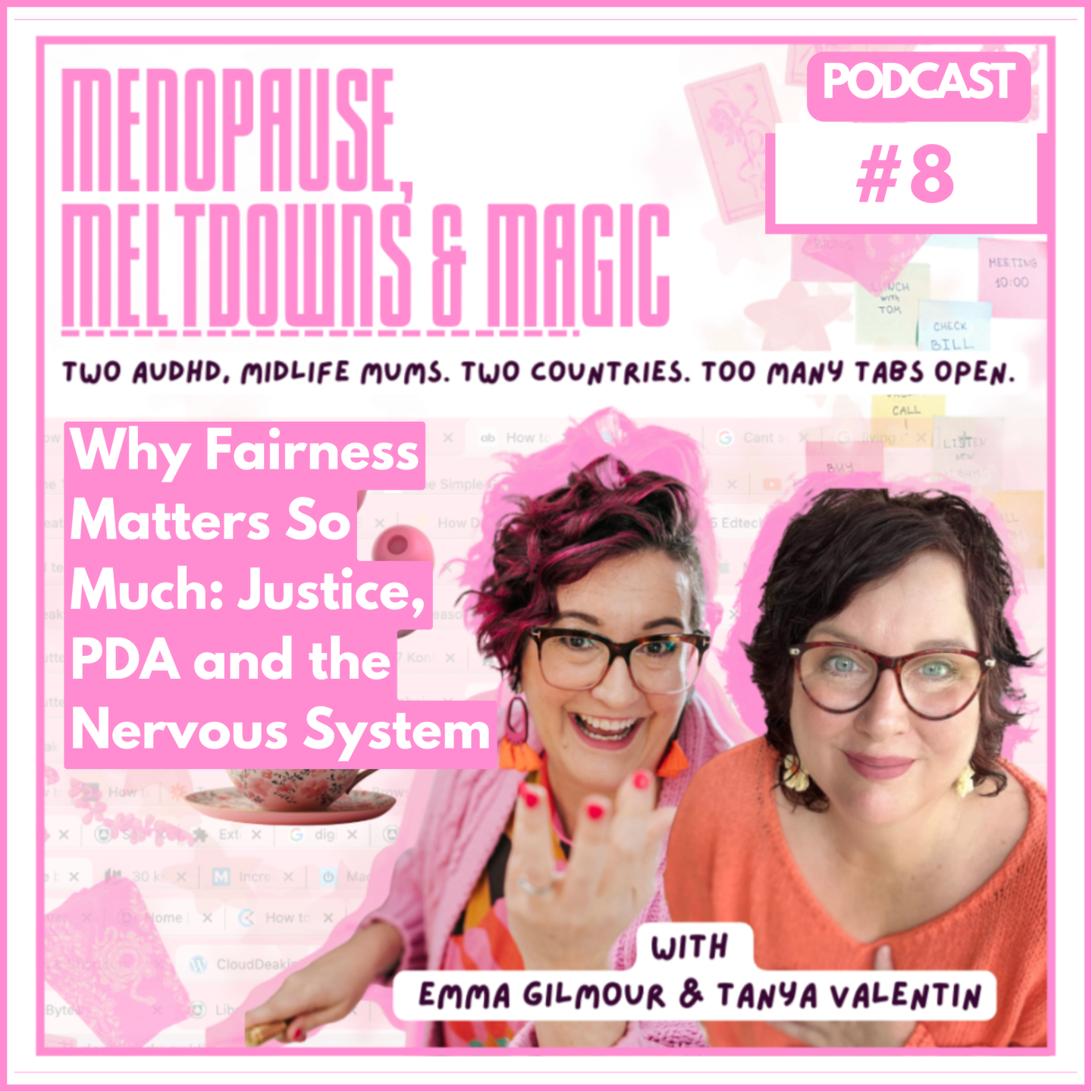
EPISODE 8
When Support Hurts: Burnout, Belonging and Trusting Ourselves Again
In this episode of Menopause, Meltdowns and Magic, Tanya and Emma explore a complicated topic for many neurodivergent families:
What happens when the “support” being offered actually causes more harm?
Together, they unpack the long middle of burnout recovery, that messy, uncertain stage where things may appear to be improving on the surface, while nervous systems are still overwhelmed underneath.
LISTEN NOWShow Notes
Episode 8
In this episode of Menopause, Meltdowns and Magic, Tanya and Emma explore a complicated topic for many neurodivergent families:
What happens when the “support” being offered actually causes more harm?
Together, they unpack the long middle of burnout recovery, that messy, uncertain stage where things may appear to be improving on the surface, while nervous systems are still overwhelmed underneath.
This conversation explores:
- Why the wrong support can prolong burnout.
- How even “good” support can become overwhelming during deep nervous system exhaustion.
- The pressure parents feel to accept therapies, interventions, and professional advice.
- Medical-model thinking versus relational and nervous-system-informed approaches.
- The grief, guilt and vulnerability of learning to trust ourselves again as parents.
- Why body autonomy and consent matter deeply for neurodivergent children.
- The difference between fitting in and true belonging.
- How compliance-based systems can disconnect children from themselves.
- The hidden trauma many parents carry while advocating for their children.
This episode also touches on masking, chronic fatigue, accommodations in schools, interdependence versus independence, and the powerful ripple effects of cycle-breaking parenting.
As always, the conversation weaves between personal stories, deep reflection, humour, nervous system wisdom, and moments of everyday magic. Resources & References Mentioned
- Dr. Emmi Pikler and respectful caregiving.
- Amanda Diekman and Low Demand Parenting.
- Brené Brown’s work on belonging versus fitting in.
- Internal Family Systems and No Bad Parts by Richard Schwartz.
- Peter Levine and nervous system trauma work.
Podcast: Meltdowns, Menopause and Magic
Hosts: Tanya Valentin & Emma Gilmour
If you are a parent of a child or teen in burnout needing support, join Tanya's Parent Community: From Burnout to Balance
Wherever you are in your relationship with alcohol, this is your next step. One FREE hour. One conversation. Five shifts. Your 'take it or leave it' relationship with alcohol starts here: FREE Masterclass


Transcript
Tanya (00:00.322)
Hello everybody, I'm just gonna bring up Tanya and the Menopause Meltdowns and Magic podcast, which is what we're recording this for.
Let me do that quickly. a minute pause, there we go.
Tanya (00:23.374)
There we go. Beautiful. Everyone's here. Hello. Hello. Hello. That was very smooth this morning. That was. I got the message straight away to say that you'd gone live and it worked. I got the notification this time, which is great. Winning. How are you? I'm good. I'm good. Good, Yeah.
Yeah, I'm good. I'm good. Thank you. It's nice and sunny here today. How's it with you? It was sunny and really blue skies this morning. I'm noticing we're getting a little bit more cloud. So, yeah, you know, that's what it's like living in New Zealand when you're in like a long, live on a long, thin island. we, weather is very changeable here. It's one of those things.
It is here as well. So welcome. we, I was talking to last night saying, what should we talk about today in the core? And I had just looked at Tanya's had posted something about sports a few days. Was it a few days ago? Yeah, it was a few days ago. Yeah. Do you want to talk about that post and then maybe we can just like carry on the conversation from there? Sure.
So it actually came from a comment that a parent left on one of my posts because over on my page I've been talking a lot about that long middle part of burnout recovery and how sometimes, you know, we, there's lots of people talking about, you know, the sort of like the really acute burnout when, you know, everything crashes. But then
You know, we kind of enter, and you would have known this too, Emma, being a parent of children who have been in burnout. You know, there's this long sort of like middle part that sort of comes after that where things can just feel quite wobbly and tricky and inconsistent and unpredictable. And a lot of times you're wondering like, am I doing enough or, you know, am I doing this right?
Tanya (02:46.54)
because there is no sort of like other points of reference in your parenting journey for this, or there isn't a lot of information about what the stage should look like. So I started talking about that and then a parent actually came in and commented and said, you know, the wrong support or can we talk about the wrong support being like
keeping children in burnout or even autistic adults in burnout for longer than they would have. And I really started thinking about the different supports, and I'm going to put it in the better commas because some of it doesn't feel very supportive, that are out there, the things that parents feel like they have to do to help their children recover and how
the wrong support can be just as, I think, even more damaging than no support at all, right? Because it can really put you back and put your family back. So that's what we're going to talk about today. But I also just wanted to preface before we get into this discussion, we're not talking about all support providers here because, you know,
Because there are lots of providers out there who care and who engage in education and curiosity about the person in front of them or the family, who show willingness to learn from lived experience and adapt, or even support providers out there who have their own lived experience.
of burnout or being neurodivergent or being a parent to a neurodivergent child. And people are doing really great things out there. So I don't want this discussion to be about like all providers. So I just really wanted to just acknowledge those people at the beginning of this discussion so that people don't think we're just talking about everybody. you know, that's interesting because I've almost got to
Tanya (05:02.583)
almost third layer to it, which is even great support providers can be the wrong thing sometimes. Sometimes that's the piece I was kind of like, because when I was reading yours, was thinking of it from my perspective in that we have amazing support people, but sometimes the just the just trying to
engage with support, make appointments, have people in your home, go to support appointments, no matter how wonderful the support people are, can become. So I think there's kind of a third element to it, which is, you know, it can become for the children, but also for the parents of the children, another layer of stress. yeah. So I think it's worth kind of like having that.
like thread as well, which because in that way it's almost nothing to do with quality of the support either. Like they can be wonderful support. Yeah. But if you can't get out of bed. Yeah, well that's the thing, right? in your home, it's nervous system dysregulating for you. It doesn't matter how bloody neuro affirming and wonderful the support is. But yes, there's also this, someone was writing recently in
a sub stack, one of the neurodivergent people, and they were writing about how, how it's sometimes the most helpful thing can be to say no, to help. Yeah. And how much, how difficult for us emotionally is to do that, because there's, you know, this also this kind of attitude in that someone's offering you help, so you must accept it. Yeah. And so that's another layer as well, which I think is quite interesting too.
Yeah, no, there are so many layers to this. know, social commentary or the cultural perspective is that, as you say, if support's being offered to you, you have to take it. Yeah. Or, you know, if you just get support, things are going to be better. Yeah, support equals...
Tanya (07:30.734)
somebody's no longer neurodivergent and able-bodied. Yeah. And there's so many layers here. It's so complex because we can, like, depending on where we are in, if our families and our children or ourselves are in burnout,
Tanya (07:55.331)
there are times where I think not having support or not having external support is actually the healthiest thing that you can have, right? And then there are times further down in the track where you might have more capacity and the right supports can be wonderful. But then there are also so many people out there that I think because of the nature of us
as a global culture still really understanding neurodivergence. You know, people can say that they're neuro-affirming, but they aren't really. It's like people saying that they're not informed. Yeah. And they're not at all. And then if we engage with people who don't adapt to our needs or don't understand our needs or we feel judged,
or we feel traumatized by that support, it actually just pushes you back into burnout. like, there's so many, like, little layers of... And you're like you say, but the medical model as well, like, for example, if, for example, for me, because of the trauma that we've been through with bad support, I'm now incredibly tough and...
vigilant about who I allow into our family. And so I only, I only work with people that have been recommended to me by other people who I respect. And I also only work with people that I have spoken to before, will never let somebody speak to my child again, without me vetting them first. again, it's really interesting, you know, we can you can research and be on a waitlist for somebody and they're like, no, the waitlist is full, but you can have this others.
person that you don't know from Adam. And they always get so cross with me when I'm just like, I'm sorry, I'm not interested in that. And they're like, well, you'll have to come off the waist and so I that's absolutely fine. I will come off the waistiness, but I'm not just going with somebody, some random person with my child is they're too precious. And they've been hurting me before, it's never gonna happen. So but people get quite shitty with you. And I think that's another element to be, you know, for particularly for moms.
Tanya (10:16.88)
it's that constant dealing with everybody just being a little bit irritated and disappointed by you for your refusal to accept. Yeah, yeah. The status quo or whatever they want you to do. You know, and I also just want to acknowledge the personal growth that we as parents often have to do to get to the place of where we can actually feel safe to say no.
I don't even know if we feel safe when we're saying, for me, I still don't feel safe when I say no, and I feel horrendous afterwards, and especially because it's often not received well. And we still have to do it, even though we're trudging into our open wounds while we do it. And that's really tough. is, that is, absolutely. And I also think another element of this is that
Especially in the, I don't know about other cultures, but in like the, the Western sort of model of healthcare. There is this assumption that
If someone's struggling with their mental health, then either medication or therapy is like the obvious next step. And so a lot of times, especially when our children go into burnout or they start to struggle, and where we should actually be sort of pulling back on therapy and the amount of appointments and the things.
that we're doing because all of those are just demands that reduce our children's capacity and reduce our capacity. But there is this expectation that you're going to go into one of those routes. And if you don't, people assume that you're not trying hard enough or that you are a bad parent because you've decided. Actually, I...
Tanya (12:24.868)
We are just taking a break from therapies and interventions at this moment because I can see that my child just needs to rest and have zero demands. And I can see you're nodding along to that, Emma. Yeah, 100%. Because for me, it's very similar what you're saying. And I think for our family, we've been in that place for quite a long time. Because we did have, as you said, we had, you know, and I think when you
got to start on this path. mean, you've never heard of autistic burnout, usually. Half the time you didn't even know you were a new, depleted family. And, you know, we've been brought up with that, haven't you? You know, if there's a problem, we fix it. You know, with a problem, there's a solution. And I think one of the big things for my personal growth has been, you know, realizing, because I always, I don't know, I think it might be part of that sort of 80s, 90s, cultural
upbringing in the West around, know, if there's a problem, if you try hard enough, you can solve the problem. Yeah, yeah. There's a solution. And there is a solution. It's just that it's not what we, know, what, know, in our brains, it's like something, someone gets ill, you give them medication or you treat them to, you know, kind of almost fix the problem. And
You know, it's such a big conversation, really, it goes wider than children and burnout. it's this idea that we, know, the minute something's wrong, we take a pill and we fix it. Or we go to therapy and we fix therapies, a pill, and we fix it, or we go to an OT and we fix it or whatever it is. But it's not, know, this is, and this is one of these times, when it blows your brain apart, where you kind of realize that this world order that you've been
condition to believe is how things work isn't how things work at all. Yeah, like it's like, well, actually, they that person isn't actually broken. They're just having a reasonable response to a environment that is unsuitable for most humans. Yeah. But then they're having more of a reaction to it because they're more slightly more sensitive human or because they've had more trauma or whatever. And then your whole world is like, it's like a
Tanya (14:52.785)
this whole journey for me anyway, and I'm sure for you as well. It's like, it's a tumble dryer. You go in and you're like, I'm thinking this and I'm convinced that this is it. if I, you know, throw enough things at the problem, will solve. And then you start to read. And then, you know, the real paradigm shifts is well, what if that person or we are not the problem? And then that's, that's kind of like shifts everything. then it's like all the ground's gone beneath you.
Yeah. Right? Well, what do we do now? What if we got the problem? And what if the things that we thought were the solutions and the people that we thought were the wisdom aren't the wisdom?
And then we're like, oh my God, we're floating free. We've got no freaking idea what we're doing. What are we doing now? Yeah, yeah. And I think we also, a lot of people, large part of our cultural narrative or the way that we approach parenting is about removing the parent from their own instincts.
and their own knowing and placing that trust and all our sovereignty as a human being in something outside of ourselves. And then when that stuff outside of ourselves is not the solution, but we've also haven't been taught to trust ourselves, to trust our judgment, to trust
what we're seeing in front of us with our children, we haven't been taught about that it's okay to trust our understanding and our relationship with our child. It can feel when that ground or that sort of realization happens that outside of you can't fix the problem. And you've also been removed from your own
Tanya (17:01.017)
innate sovereignty as a human being, as a parent. I think that is probably one of the reasons why it feels so overwhelming and discombobulating for parents because now we have to find like, how can I learn to trust myself again? How can I learn to trust my judgment? And a lot of times before parents
get to that, we've made decisions that we've thought were the right decision. they've actually caused harm. we're really starting with this feeling of I can't trust myself, I make mistakes, I'm stuffing this up. I can't trust myself and I can't trust others. Yeah. You know, you, you. Yeah. It's terrifying. I remember starting to see the harm.
that was being done by the externals and thinking, because I put all my trust in them before I knew anything, and then thinking, okay, well, no, I don't know. And I think add into that as a neurodivergent parent and a female assigned at birth human, where often we have low interceptive awareness anyway, or hyper, which again can overwhelm us, and within the patriarchy as assigned female at birth,
From birth, we have been required to suppress our needs and perform and diet and exercise and be extrovert and all of the things so that we've not only just, we're disconnected because we have systems that take over ownership of our children, but also that we
don't have the fundamental biological skills even to connect. We need to learn to connect back to self, to trust self when we've been told all our lives that we're untrustworthy. Yeah, yeah. Hello. And that can just be a really terrifying place to be.
Tanya (19:22.96)
I also just want to mention something. I have spoken about this very briefly, but I want to know if you've had a similar experience. When that happens, you know, like, I don't know, this was my experience. When my daughter was in her like, absolute crisis,
Tanya (19:46.257)
It was almost like, I like to call it like a spiritual awakening because all of a sudden you see all this stuff. Like you can see like the harm of the patriarchy. You can see how all of this has threaded through everything. Well, it was my experience. You can see how like how you were raised.
influence how you raise your children and like it's it's quite mind-blowing to like have this big sort of perspective shift and almost like download of information that just totally opens your eyes. I don't know if you experienced that too when you know when your children were in burnout but it's almost like you're showing things that you just
can't unsee anymore. Yeah it's like your world view shatters. Yeah. you're cracked open and everything that you held to be true and I find this happens so many times in life anyway but yeah you're like I'm cruising along I've got this really good idea of what everything is and then you're like no yeah it's not like that you're not like that your children are like that
And yeah, go figure. it's like, it's, yeah, it's totally, and even like, you know, when you say, I don't know, for me, like I, I, I, I, it didn't take me too long to get to the, because I could see the harm. And I knew mama Ben knew she needed to step in and stop this shit right now. Yeah. Because otherwise you could see the harm. And I knew the things that they were saying about my child weren't true.
And I knew that they were making her bad and she wasn't bad and I could only take so much of that. Before I had to step in and go, no, no way. But I still really struggle and I'll be struggling with it this week really badly with advocating and being received badly. And I still, you know, find myself like I was talking about last week.
Tanya (22:10.874)
Yeah.
reacting to my cultural conditioning around, you know, not wanting to ask for more than I deserve, you know, all that kind of stuff and being, you know, wanting to be liked, not wanting to be disapproved of. And I think when you're advocating for children who need more than a neurotypical person or need different or require extra, that makes total sense that people find that difficult because it means extra work. So of course it's not going to received.
But when you also have RSD yourself and you've got the trauma of keep having to do this and keep having to advocate for such a long time. I think for parents it's so hard to just keep stepping back into the ring and just you could just feel all your inner wounds just going god this is so awful I hate this so much I wish I didn't have to do this all the time it's just shit.
I think a lot of that approach from like outside people, it only really looks at, you know, from that medical model, only really looks at the child and what's wrong with the child. And it never sees the child in the context of the family or the community that they're in or the culture that they're in.
And it's like, all like, OK, we just need to fix the child. like, that's just like a minute part of the picture. And it just makes me so angry as well. like, lots of, I constantly do work on myself with this stuff. Are you not? Like, I'm literally like, what's going on up and down? What's this trigger coming from? Come on, it's OK. You know, we're safe, you know.
Tanya (24:13.906)
But it's interesting because it's like, well, are you safe? I sometimes we're not. Sometimes our children are not safe. And so it's very difficult to be, was reading somebody talking about maybe we shouldn't be talking so much about trying to make things safe as in trying to, because systems aren't safe for a lot of us. You we aren't going to be treated in a relationally safe way. And I mean, yes, that would be lovely if that was the case. And in some cases we are.
But there's going be a lot of times we're to come up against people who do not know any better. so, you know, how is it that, you know, how do we kind of install that's your inner belonging to self and inner dignity. And I really like that language, like belonging and dignity rather than saying safety, because it's all good to say safety.
And yes, we can be nice to ourselves and yes, we can be kind to ourselves, but in reality, we can't make unsafe things safe. Yeah. Otherwise, just gaslighting ourselves. absolutely. You know, I totally get that. And yeah, I do really like that language of belonging and dignity. And, know, I know that Brene Brown
did a lot of work on sort of belonging versus fitting in. And, you know, a lot of times when we, what we think is belonging, is actually just fitting in. But fitting in actually requires us to abandon ourselves. And we don't have a true sense of belonging because we're just trying to fit in and be part of the status quo.
Whereas true belonging, I feel, is something that we give ourselves. It starts in ourselves, like, hey, I belong to me and no matter what situation I'm in, I can still hold on to that sense of inner belonging, right?
Tanya (26:30.223)
We spend so much of our lives.
centered around fitting in that it's sometimes really hard for us to find that belonging inside of ourselves. It's really interesting. So while you were talking about that, I was thinking about this, you what's the opposite of belonging? What's the opposite of the shame of asking for more and asking for equity rather than equality? And I was just it was that the words
that dignity and belonging felt quite good as well in that context. know what mean? like, yeah, because it is, I'll give you an example. My youngest is going on camp next week and there's been a lot of backwards and forwards over it. And then yesterday I got an email talking about how on the last trip she'd done with school, which was the first trip she'd done. And now she's a
with chronic fatigue and in burnout she had struggled with getting up in the morning and that had made everyone very cross with that and I only found this out like yesterday and my mama bear was just like so I said what can we do what can Daisy do to make this better? First of all her going on camp doesn't mean she suddenly becomes a neurotypical kid without chronic fatigue so what accommodations are you going to make to help her?
rather than shame her for a medical condition. Yeah. Neurodivergence, it's rather like to celebrate her for being brave enough to come along and have a go, rather than like, we'll be sat there, bare faced. Yeah. Give her hand. Exactly. It's that kind of thing. It's like expecting her to fit in rather than...
Tanya (28:31.171)
and treating her like somebody who belongs. That she has to be there exactly as she is, meet her where she is. Let it be a great experience for her rather than something that's little bit tinged at the disappointment of others. Because the truth is if she went and had a really great experience, she might have more capacity to actually do more things.
versus going to something and it feeling really unsafe and people are judging you all the time and like what does that do to to a young person's self-esteem, their sense of self but also just their capacity levels because if you're constantly on edge feeling like you need to protect yourself because people around you don't understand you, don't include you
don't accommodate you and judge you by neurotypical standards. Yeah. You know, of, of development and of capacity. It's, it's really, it's really tricky, isn't it? It is. Yeah. And I was just thinking exactly what you're about, because we know that for most of the autistic kids in burnout and chronic fatigue, it's never system related, right? No system shutting down from, from stress. It's a stress response.
It's like, how do we treat people with a stress response? Do we get all military with them and shame them? But I think, you know, I'm going to think about when I was in education as well. A lot of training in schools and, you know, the education a lot of parents receive is very much about behavior management.
and looking at how can we fix behaviors and not actually taking the time to realize, to recognize what sits underneath that behavior. And that if we actually work on the deeper causes, that it's going to be way more effective at managing the behavior than
Tanya (30:55.289)
the traditional ways of focusing on behaviour. And not just, you know, with children, but with us as adults as well. find that with, you know, working with people with food, body images and alcohol struggles, it's, you know, it's never the behaviour has got nothing to do with it really. The behaviour is the sort of like the band aid, isn't it? the behaviour is the cry for help.
The behavior's there. Something's not OK. Can you help me, please? I don't know how to do something yet. You know, I'm not I don't know how to do this yet by myself. I need some help. I think, you know, for us, I just want to acknowledge the courage that it takes sometimes to actually ask for help in the first place. My God. And, know, that's us as adults, alone poor little tinkers who, you know,
adults haven't always been the safe places for them to land when they've asked for help before. Adults, we find it hard enough to ask for help. So many of us, And I think about some of the stories I've heard from some of the parents that I've worked with, you know, where
things that have been put in place to support the wellbeing of the child have actually just been, you know, box ticking, needing to fit into some sort of compliance model. That whole sort of, just get your child to every morning, come and touch the gate. They don't need to come in, you know, like.
I don't know who ever thought about that. I know it must have come from some kind of exposure therapy framework, but you know.
Tanya (32:58.076)
That is just something that actually traumatizes children more. I've heard of some parents who have to meet online for a weekly wellness check with the school, someone from the school every week because their child is in burnout and can't go in. Just all these extra stresses and hopes that sometimes parents of neurodivergent children need to
jump through because because people don't trust people like you just believe us when we say yeah it's like so many things isn't it i mean we went through so much of this and there's so many things i even remember we we went to this special school that we were sent to from the royal children's hospital in melbourne that was like for kids who were struggling with school attendance
And I was like, yeah, but when they're in burnout, and really it turned out to be, was an exposure therapy thing. There were nice people, but the paradigm that they were trying to meet was, we'll get your child to school more. And when Daisy went, she was so full of excitement for it all. And it gradually, capacity waned. She really wanted to be there, but someday she just couldn't get out of bed.
and the lectures that we, well, it's not gonna work if you don't show up. It's like, are you serious? Like my kids in bed, can't lift her head off the pillow. And you're treating her and me as if we are sat around scratching our bums watching Netflix, having a day off, know, shits and giggles. She can't eat. Yeah. Or open her eyes.
And yet you're, yeah, so it's just, yeah, the difficulty as well is seeing the impact, know, in my mind from the adults that I work with of compliance-based parenting on adults and, you know, really seeing that I'm really wanting to protect my children from growing up the way that we did.
Tanya (35:21.042)
because it does have some really, really horrible, horrible long term impacts for most people. That productivity culture that force yourself to push through. You know, it's people break, people get all kinds of diseases from it. It's really a very unhealthy way to be. Oh, 100%. And I...
I've just recently, as you know, I've started working just like one day a week at our local polytech to support students. And I said, but the students who come and see me all the time, they feel really embarrassed to be there and to be asking for supports. And then like,
It's so hard sometimes for them to even accept accommodations or support because their whole life they've been told, you just need to push through or you're just being lazy or you just need, you just need to apply yourself better. you know, these are sort of people, know, sort of people my, my children's age, sort of like, you know, school leavers to sort of like 25. And, you know, I can already see
how that's really affecting them and their education because there are these accommodations that we can give them. There are these supports that we can offer them. But it's so hard for them to accept it because of the social commentary around it or just like how they were in school systems or their families didn't really understand.
My heart just breaks for them sometimes because it just so hard for them sometimes and it really doesn't need to be.
Tanya (37:27.546)
It's a really interesting piece as well. Are you talking about the actual concept of support as well and box ticking? Yeah. Because I was thinking from us when, when our kids were diagnosed and things started to get really hard at school, there was this like set supports that were like, well, this is what you give to the neurodiversion children. Fidget toys, headphones, a card to say they can go to a loo.
accommodation to say that there's nothing wrong with any of those things right? But it was almost like we'd throw this pack at each kid and this is, there we go, accommodated, sensory room, accommodated and yet for my, like for example for Daisy very similarly, she is such a perfectionist and she's such a high masquerade. The idea of her using anything in her...
brain that kind of differentiates herself from others is very difficult. So all her sports have to be kind of like under the radar. I heard this really interesting, I was in a professional development the other day, given by Amanda Diegman, everybody would know her as low demand Amanda. And she had a really interesting concept. I was like,
Yeah, it's that, you know, she said if you're at a Virgin children are given accommodations in a classroom, that the only way it really works is that everybody in the classroom gets the same accommodation, which, you know, goes, goes against the whole like, you know,
Fairness. Fairness or whatever. or you should only get this support if you are neurodivergent. But her argument for this, and I totally agree, was, know, if everybody needs a little card to go to the bathroom, or everybody gets to access
Tanya (39:43.73)
noise cancelling headphones or fidgets or whatever if they need them. a break when they're tired. Yeah. How awful. Yeah. That is one of the best ways to actually support neurodivergent children by actually normalizing accommodations and support across everybody. And I know that sometimes that's harder for people to put into place, but. Yeah.
I did really get me thinking. think it's, I mean, all I've ever learned and all like whenever I go into the accommodation kind of meetings is this mantra that, you know, if you make the accommodations for neurodivergent kids, everybody benefits, you know, it's really helpful for neurotypical kids too. It's just that the neurodivergent kids can't function without it, but it makes everybody's world, everybody's educational experience better.
by having those things. And so why wouldn't you? Yeah, exactly. One of the examples that she showed, she spoke about in like real-term life is that Siri, you know, on our iPhones, we actually created as a neurodivergent, like as an accessibility tool, right, for neurodivergent people or people with disabilities. And like, it's, you know,
millions of people or billions of people now benefit from like Siri or Google or Alexa as a support but that initially the initial concept was around accessibility support. Yeah. It's so interesting how things are changing around stuff like that, isn't that? Transcribing and stuff like that. It's like, so it makes sense.
For me, I find things on the spot really difficult to process. someone will say to me, well, what do you think about that? And I'll say, oh, that's fine. And it comes out of my mouth. But actually, I've got no idea what they said.
Tanya (41:58.932)
So change schedules and stuff like that is so good. Yeah. Well, you know, I just, I thought it was such a learning curve for me when my children were diagnosed because, also really high maskers. And just for me as a person to actually learn a little bit more about accessibility.
and things, know, like transcribers and just like that. And even just as a business owner and a coach, like how important is that to make these things available for people because not everybody's going to process information the same way. Exactly. Exactly. It's, it's, yeah, it's, it seems so funny, isn't it? Because everyone's like, it's not fair. And it's like, well, you know, kind of
There's this whole fairness thing that just...
feels really like fitting in rather than belonging. Do you think that the non fairness comes from it being a an invisible almost disability, right? Because yes, we don't say the same things about people having like, no accommodations for a physical disability. You know, like if somebody needed a wheelchair, we're not going to say it's unfair that we
Yeah. I think, you know, some kind of thing that we can obviously see. you know, and people don't have an issue with giving accommodations to that. And I wonder if it's just that sort of being sort of a more invisible disability that people have.
Tanya (43:59.666)
Definitely. I think even when we were talking today about that sort of like, you know, being slow getting up in the morning when you've got chronic fatigue, it's like, well, yeah, just because the person looks like anybody else doesn't mean that she doesn't have chronic fatigue. But one of the things that I've heard is two things. One is what you've just said. And I remember saying to our school, you know, with attendance, you know,
What do you do when somebody's got a serious illness? know, someone's got an illness where they're going to have months and months off school because they're sick, you know? Why is that treated differently to my kid with chronic fatigue and autistic burnout? Why is it that they can do a VCE and have accommodations for and my god, it doesn't make any sense.
The two pieces that I've heard from about this is one what you were saying is that it's invisible. But the other is often I think for the parents who are often it's often parents having these reactions. Or, you know, regular people in the street. But I think often it's a trauma response because they were never accommodated. Yeah, that's part of it. I think it's like I would I had to put up with a really shitty experience.
you know, I've noticed this in my marriage, with my husband and I, different ways of approaching parenting. And it's not just between him and I, I've noticed people around, like, well, I didn't get away with that behavior or that when I was a child. So why...
why should they? You know, it's almost like you have this like little toddler in you. Yeah. It's not fair. I didn't get their treatment. So why should anybody else? Exactly. And it links into my experience that kind of
Tanya (46:16.094)
black and white thinking as well around, you know.
There's some sort of...
Yeah, I don't know how to describe it without sounding a bit funny.
Tanya (46:34.581)
There's some like ableism in it and some, you know, it's that kind of, well, it was good enough for me. Oh, there was never any autism when I was growing up. Well, it's all that sort of stuff, you know. And it is really interesting to watch and we and all of us refer to it sometimes. I I know I do. Just that upbringing of like, you know.
Like you say, even the language, isn't it? I wouldn't have got away with this. Like they're pulling a fast one on us. Yeah, or even just like got away with it, right? it's manipulating. Yeah. And I feel like it's linked with words like respect sometimes too. It's that that's what I was meaning was trying to find a wording for it. But it's that kind of like
There's a boss and there's the people who should be doing the thing. The boss of the people, be it a parent, child or system. They need to do what that person says. And if they don't, like you said, the behavior is a problem, not the rules. Yeah. It's very interesting what you said about, you know, like the manipulating. And I always think like...
Tanya (47:56.277)
I remember when my children were like newborns and I was told, you know, don't go to them when they cry because they're just manipulating you. And if we think about the actual like brain development of a little baby, they can't manipulate, they don't have that brain function to manipulate somebody. just like the way our culture sort of
perceives things. Is anyone not doing what we want them to do? Yeah.
I was thinking just, you know, like often people get pissed off and I've often got pissed off. Like if your animal, like, I don't know, goes to the loo on your rug or something like that. They're doing it to spite me. They're cross with me. It's like, no, they're not.
Tanya (48:50.838)
They've just done something you'd rather they didn't. Yeah. And you're taking it personally. It was interesting because I was, was, don't know if you've ever read No Bad Parts by Dick Schwartz, that internal farming systems guy. Yeah. He starts off talking about how when the kind of missionaries came over to a developing country with Indigenous people, I can't remember which.
And he there's this letter that goes back to it's kind of on records of this missionary or reformist person saying, you know, and you wouldn't believe it, you know, the children have picked up and mollycoddled by their families all the time. I can't wait to bring in our British colonialism and, you know, really kind of get that out of them sort of thing. And it was just it's so much that sort of
traditional kind of, I guess, British and all other colonialist kind of attitudes to, you know, compliance and respect and, you know, we know best and, you know, the children have to be independent from a very young age and which we know, as you said, is the opposite of what
human beings needs in order to thrive. And then we look at the world and what's happening at the moment in the world and it's like, you know, maybe if some of those people had been picked up and cuddled a little bit more. Yeah. Well, I mean, it might not be in this situation, I'm really... You know, funny enough, like, I don't think that the, um, the goal as parents is...
for independence. Because we all live in an interdependent way with other human beings, right? And the world around us as well. And the world around us, you know. But coming back to respect, the thing that changed my definition of respect was the work of, I don't know if you've ever heard of her, you might not have, because, you know,
Tanya (51:15.355)
We often, it's kind of like a educational sort of philosophy. But there is work of Dr. Emi Pickler. And she was like this Hungarian pediatrician. And she was sort of commissioned to create all these orphanages around the end of the Second World War.
And her approach was just so beautiful and amazing. And she had all these babies and these toddlers that were dying of lack of attention and love and support. And so she came in there to kind of help these children to be able to thrive. And
Her whole philosophy is even with really young babies, we do things with them rather than to them. even our really young babies, it's in partnership with us. And it really fits with that whole sort of like my thinking around neurodivergence and PDA and all that kind of thing of how it's a relationship, right?
And so her idea of respect is that it goes both ways. That we respect children and then children learn how to respect through the respect that we show them.
and that it is this beautiful co-creation within a relationship. And one of her principles, and I remember, I think this was on Australian TV, like a few years ago, was, and I trained in this, and as an early childhood teacher, this was something that I did all the time. But,
Tanya (53:23.434)
that you actually ask the infant permission to change their nappy or to feed them or to put them to bed so that they're always the partner in this, right? And then while you're doing it, you're explaining and you're sort of labeling all the, you know, all the things that are happening so that the child doesn't feel like you're just doing it to them. Yes, exactly. And
I remember the backlash this woman got on TV because she said that parents need to ask their infants permission to change their nappies. And everybody was just, know, why should we have to do this? And, you know, all this kind of thing. And I just thought like,
Tanya (54:18.583)
people just, you know, like it is just very much that children just need to do what we tell them to and there's this whole hierarchical thing. But that's where I started learning a lot, like deviating from behaviorism in my own approach as a teacher.
And I think it's just really something, a really beautiful foundation to my work that I now do in the neurodivergent space. So, yeah. I see there's been some... Kate's just written, from beyond leadership, she's written similar to Jean Liedloff. I'm probably saying that wrong. And the continuum concept, do you know about that, Tanya? don't.
Tanya (55:09.782)
She says, I do love hearing about Emma Pickler. Love this. And then when I did my infant massage, I recall asking my infant daughter permission to massage. I feel like I had something. I feel like I remember doing baby, some kind of baby massage or some kind of baby thing with my eldest. And it was like that as well. think you would that was the teaching, wasn't it? Sort of like, you know, ask permission. But it's so lovely, isn't it? It's just.
makes so much sense now. And she's going to asking her infant daughter permission to massage and she screamed no, she's 28 and she's still not can handle touch. That is so important though, isn't it? We're not all the same. We don't all want the same thing. And some of us love touch and some of us hate it. I know for lot of parents of ND kids, it's very hard, you know,
that whole getting used to your child not wanting to be touched by you. can be really, really, really, you know, it's another another area of grief, can't it be for people? Yeah, one of my one of my children can't handle hugs. You know, they they tolerate she tolerates it sometimes. But she does it very much for us rather than, you know, us. And so I've always been the habit of asking my children
permission to touch them or to hug them before I even go to do it. Is it okay if I hug you or is it okay if I touch you? And sometimes the answer is yes and sometimes it's no and I respect that because that's their body and their person. It takes a bit of time though doesn't it? I know for me
I still like, even though I'll pretend it's completely fine, I still do feel a little bang of I wish it was okay. Even though, I kind of like, I try so hard to be like, okay, cool, no worries. It's hard to not feel like it's a rejection. I do get And I think that's it because I think a lot of us do have RSD anyway, don't we?
Tanya (57:29.536)
But then it's about not making it, try not to make it about you, you know what I mean? In those situations, I think. I think one of the hardest parts for me around, you know, hugs and physical touch and things like that is, you know, when I can see that they're upset and I just want to give them a hug. And during those times, actually, that's the least time that they would want a hug. Yeah. You know, and so...
I have to put aside my need in that moment to be able to comfort my child in a physical way and respect their need instead for space or for me to show presence in another way that feels more acceptable to them. Yeah, that's beautiful. Beautiful to speak to that too. And it's so important, isn't it? Because in reality, so many of us
have grown up and I speak for myself, being in situations where I've never been allowed my own autonomy and so I didn't know how to have autonomy. And so for example, I'd end up in situations with guys when I was younger that I didn't know how to read my own warning signals because we weren't allowed to have our experiences as children. Usually we had to go along with whatever the adults.
So there's a lack of attunement to self. And there's also this sort of concern, I don't want to get it wrong. And then, you know, I'll be, you know, be laughed at or be considered, you know, or, you know, who was she to think she was all that sort of stuff. Yeah. And so, know, really, this is actually so important what you're talking about, especially with neurodiversion kids who can be so vulnerable to abuse to have to learn that they can say,
and that adults do listen and that they do honor and they do respect their body autonomy is really important. And I think that's what's so powerful about, and I see that Kate's putting there about a connection with babies and community engagement. It's one of the things I think is so powerful about even just from really young children where they might not actually know
Tanya (59:51.244)
the language or understand that when we're teaching that them from a really young age that you have a say over your body, your body is your body. That's something that becomes your foundation of who you are as a human being, right? Like the other thing that we often did as PICLA practitioners, as teachers was
we would put our hands out to the baby or the toddler and then they had the choice of whether to actually come to you or not. And if they didn't, then we had to kind of like, we had to accept that. And it's so funny, you know what you're saying about the adult experience? was part of the training that we received as we were sort of
put in a room and then somebody just came and they tried to pick you up from behind or tried to come and like wipe your nose for you without like warning and like you got that first hand experience of what it feels like when somebody just comes and like does something to you without warning or without your permission because it's adults we're like well you know this is my body you have to sort of
you have to ask me before you can just come and grab me. But for children, we just kind of assume that that's okay for them to be treated that way. Exactly. And then we wonder why, particularly female assigned Earth humans, we struggle so much to know what we need. Yeah. Because no one cared. Nobody, you know, we were required to be compliant. So we had to stuff down our needs because otherwise...
it would have felt unbearable to us if we were in full feeling of our needs being violated all the time and being dismissed. It's no wonder half of us are, you know, really struggle with connecting to what we need because the only way to manage that sort of constant...
Tanya (01:02:08.065)
Disregard of your humaneness would be, you know, would be to shut yourself down to it. Yeah. And I think that's why,
interoception work and trauma work need to be done at the same time. Yes. You know, we can't be teaching people to bring their interoception awareness back online without actually dealing with why, I mean, sometimes just a natural body response, but a lot of times it is in response to trauma. It is in response to having our
experiences dismissed or having no say over our own body autonomy. And I think as well, you know, with that, when we're working on increasing interception, like you say, it's like that, you know, tiny, like what Peter Levine kind of talks about, like, I've forgotten the word for it now, pendulation, know, we touch in, come back to home, touch in, come back to home. There's no go and sit in your
Go and sit in your physical experience right now because that's going to flood somebody and re-traumatize them with the same thing. It's all just, we know so much more now, don't we? think, and I do think that all the stuff like you're talking about with your child and the things that you've done with them will really reap their award in the longer term.
their sense of self. Yeah, I I noticed when I started
Tanya (01:03:59.832)
developing more of a sense of self as a parent, as their mother. Just that had a positive flow on effect for them because they could see, you know, my mum is actually trusting herself and doing these things for herself and advocating. And so I actually, I have a right to that as well. Like the example that we set for our children,
is so incredibly powerful. then when we change the way that we see things, we naturally do things differently for our children. And then has that positive flow on effect that, like, I don't think my children will ever not, like, will ever parent in a way where they don't think, where they think they...
they should, they just have rights over their children's body autonomy, because it's just something that has just been part of our life. But with work that I had to do first, to then be able to support them in it and then, you know, it's kind of just become second nature for them, because that's the way that they have been treated by their parents.
It's a very interesting point because I think for a lot of our generation, we grew up with and many of us are still living with undifferentiated parents who see their children as an extension of themselves. And, you know, I see, you know, with the adults that I work with, the difficulty of that. And, you know, I'm by no means perfect with it all, but I think
I grew up in a pretty unboundaried environment growing up. And I still, you know, I've still got a lot to learn in this area. Because I still get the little, I still make it a little bit personal, even when I know. It's hard not to, but you know, I think, I think as a generation, we are
Tanya (01:06:20.321)
We're probably, you know, we're a generation of cycle breakers. And so we are doing a lot of that work so that our children don't have to do that work. And when you're learning, like when you're learning new behaviors, almost like learning a different language, right? And if it's not your native language, you're going to make mistakes because, you know, that's not the language that you grew up with.
I love that. Very compassionate. Very self compassionate. We have these conversations and then they go to all sorts of very different places. They're connected, they're... it. I think it's a very zero-limits way of having a conversation, Yes. That's why I like it so much, I think.
And I loved having Kate join us as well. It's always lovely having her on too, I think. Yeah. And I've never heard of Jean Lee Lough, so she sounds like a good person for us to know of too. Yeah. Yeah. I'm conscious that we're posting off our time. think we need to look at our magical moments. If anyone else has got a magical moment they want to share, Kate, please feel free to share as well. Yeah. Do you want to go first, Tanya?
Yes, I actually had one this morning and I was like, I know exactly what I'm going to do to share my magical moment. So I went for a walk this morning and it was incredibly misty and the sun was coming up. And then I looked over to the mist and I do know what a Brocken's, a Brocken's specter is. Please tell us. So it's like when a person stands in front of the sun,
and like mist or some kind of cloud like low-lying cloud yeah and then the sun portray like projects like a rainbow onto the mist but the person that's standing in between it they're kind of in the middle of the rainbow so it was like this big
Tanya (01:08:41.208)
big circle sort of rainbow around my shadow and it was just like the most amazing thing. I'm like, oh my goodness, look, there's my shadow and it's in the middle of like a circle rainbow. my goodness, now I have to go and look this up because I do not know what it is. That's incredible. Yeah. Wow. I just took a photo of it and I brought it home and I said to, yeah.
Can you send it to me after? Yeah, yeah, I will. I want to know and I want to use that word and I want to try and experience that sounds amazing. My whole morning this morning was like going down Brock and Spectre, um, rabbit holes. I love that. That's so cool. I love that so much. Uh, was like, uh, my medical moment this morning was a little different.
It was a very small magical moment and it was, I've been having, this is gonna sound really old ladyish, I've been having really stiff hips. I always get stiff hips, where I get like, carry my stress. And I'd be doing a little bit of qigong in the morning to kind of like, shoulders and hips really. And I thought, oh, I'm gonna go outside in the garden and do my hip for stuff. Cause I thought, oh, that would be a nice thing to do.
And as I was doing a sort of like arms up thing, I don't know the name for it, the sun came just over the fence and was just like beautiful. You know, like when you do like a, I don't know, the yoga one where you'd like, you know, you, when you, can't remember the names of all these things. I'm so glad. But you know, it's like a morning salute or whatever it's called. was a Qigong one that I was doing. And then every time I looked up, there was this little sun peeking through the fence.
It's gorgeous. Quite ordinary, but lovely. was really fun. yeah. I think that sometimes the most magical times are in the ordinary, right? I agree. I agree. I agree. Oh, well, I'm to go and find out about that what you just talked about. And I'm not using very good English either. That what you just talked about. And I'll send you a... I'll you a... The photo.
Tanya (01:11:05.304)
Maybe we can put it on the, when we make the podcast we can, you might not be comfortable with that. So no, no, no, that's okay, I don't mind. It was a really amazing thing and I actually didn't even know it had a name. And then I found out like, it's a phenomenon that often happens when people are mountain climbing. Oh, for goodness sake. So it's almost like you were mountain climbing this morning. But I wasn't, but you You were embodying it.
Ah lovely, lovely as always. Thank you so much lovely Kate for joining us and Tanya for your wisdom and yeah it's lovely. I love listening to how you are with your children. It sounds so yeah like you're such a wonderful parent from what I hear. You should hold yourself with great.
Well done, my friend. Same to you. Same to you. We're all just doing our best, Emma. you know, my mama bear heart goes out to yours. Me too. And Kate's, well, I know that she's a mama bear as well. Sending love to you, Kate. And all the other mama bears who are out there at the moment. Amazing humans. We really are. Take care, Cherub. Lots of love. You too. Bye. Bye.
Mm-hmm.
Work With Emma
Single intensive counselling session — $247
1 hour 30 minutes - Initial Consult
You will get: Notes, Resources, Session Recording - downloadable for 7 days post consult
We will map out your personal roadmap to finding your version of that illusive ‘take it or leave it’ relationship with alcohol. Using my 3rd Way method. This is a complete option in itself and there will be no hard sell on anything else. If you do decide to continue with any of my packages afterwards, the cost of this session comes off the price as long as you book the longer program within a month of the session.
BOOK HERE
Want a text when we go live on Instagram?
Drop your details below and we’ll send you the direct link so you can join us, ask questions and be part of the conversation in real time.
Opt out anytime.
YES! SIGN ME UP