
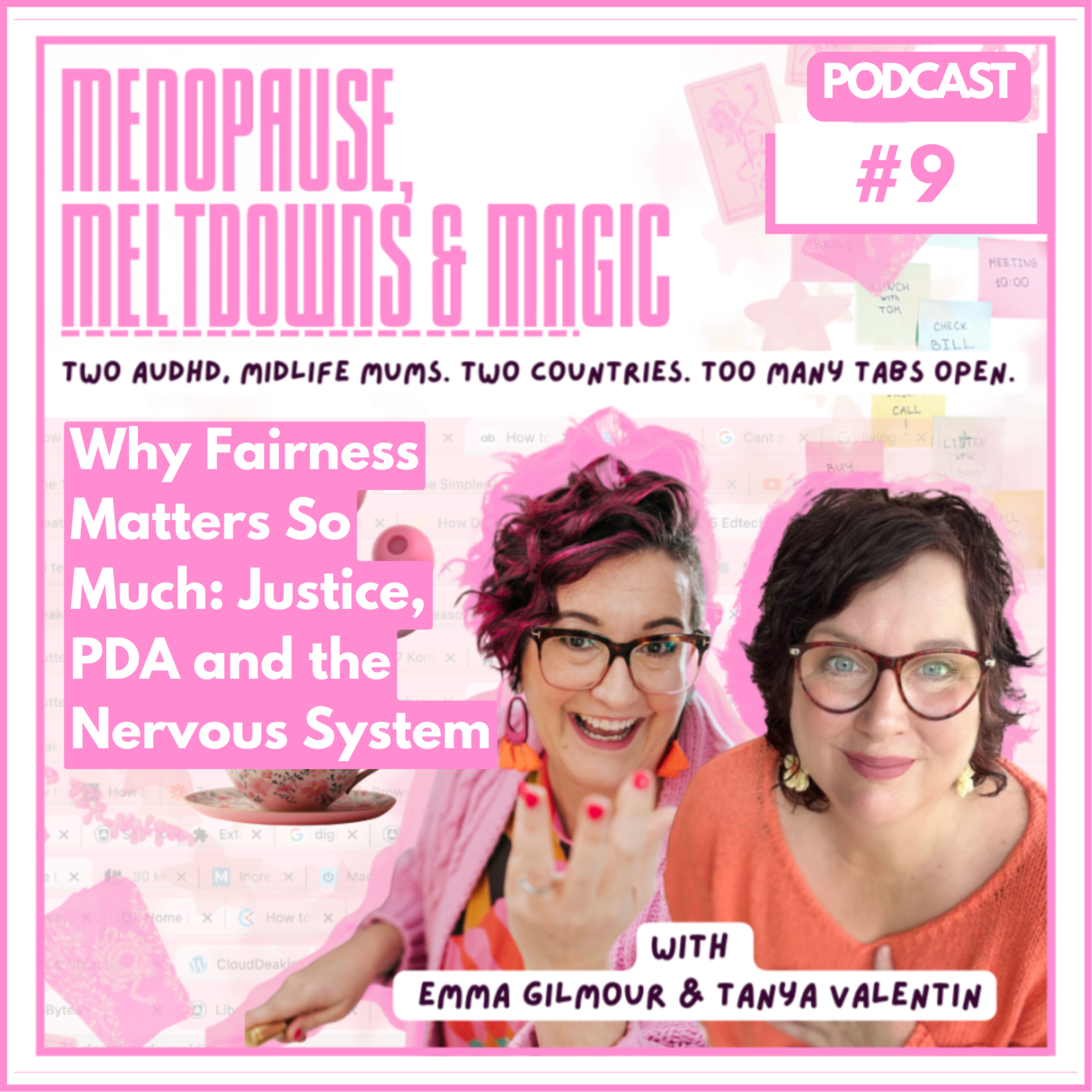
EPISODE 9
Why Fairness Matters So Much: Justice, PDA and the Nervous System
Why do some people seem able to let things go while others feel deeply affected by unfairness, injustice, or double standards?
In this episode of Meltdowns, Menopause and Magic, Tanya and Emma explore the powerful relationship between neurodivergence, fairness, social justice, and nervous system activation.
LISTEN NOWShow Notes
Episode 9
Why do some people seem able to let things go while others feel deeply affected by unfairness, injustice, or double standards?
In this episode of Meltdowns, Menopause and Magic, Tanya and Emma explore the powerful relationship between neurodivergence, fairness, social justice, and nervous system activation.
Together, they unpack why many Autistic and PDA individuals experience injustice not simply as an idea, but as a whole-body experience. They discuss how fairness shows up in childhood, schools, workplaces, families, and society more broadly, and why experiences of being misunderstood, excluded, or othered can leave lasting impacts.
The conversation also explores the emotional labour of caring deeply about the world around us, how social justice can become intertwined with our own experiences of belonging, and what we can do when the weight of unfairness feels overwhelming.
In this episode, we chat about:
• Why fairness and justice can feel so important for many Autistic and PDA people.
• The difference between noticing injustice and experiencing it as nervous system activation.
• How schools, workplaces, and social systems can unintentionally create feelings of inequity.
• Why many neurodivergent children struggle when rules are applied inconsistently.
• The connection between fairness, belonging, masking, and childhood experiences of being misunderstood.
• How experiences of exclusion can shape our responses to injustice as adults.
• The emotional impact of witnessing discrimination and systemic inequities.
• Supporting children who are highly affected by unfairness and social issues.
• The challenge of staying informed without becoming overwhelmed.
• Practical strategies for managing nervous system activation when feelings of injustice arise.
If this conversation resonated with you, we'd love to hear your thoughts. What role does fairness play in your life or your child's experience?
Follow along for more conversations about neurodivergence, parenting, menopause, identity, nervous systems, and the magic that can be found in unexpected places.
Podcast: Meltdowns, Menopause and Magic
Hosts: Tanya Valentin & Emma Gilmour
If you are a parent of a child or teen in burnout needing support, join Tanya's Parent Community: From Burnout to Balance
Wherever you are in your relationship with alcohol, this is your next step. One FREE hour. One conversation. Five shifts. Your 'take it or leave it' relationship with alcohol starts here: FREE Masterclass


Transcript
Tanya (00:02.314)
Hello! Right, I'm running a bit late, so let me just get Tanya and Menopause Meltdowns and Magic on.
Tanya (00:16.298)
that. Welcome everybody. It is wonderful.
Can you hear me? Yes, yes, I'm good. I'm good. I'm good. How are you doing? I'm good. I like your hair. looks so cute. Did you have a fringe done? I did. did. It so cute. I had it done like a week ago and then it usually takes me like a couple of weeks to get used to a haircut. And my daughter said to me, that's probably one of the most autistic things you ever said, Mum, because most people like
love to get their hair done and then they love it immediately and yeah I'm always like I'm not sure I think I need to kind of like get used to this new look. Yeah so I'm still getting used to it but I am starting to like it. Very cute I love it that's very nice I love a little short fringe it's really nice. But I hear you on the haircut thing. My son used to always go and get his haircut and then come home and be crying and like just hating it.
hating it for ages. Yeah, sometimes grandparents, but lot of the time not. Yeah, I can hardly ever get any of my children to go to the hairdresser. That's whole show on its own, yes. I agree. Let's put that in our
our notes to next, next one of our next lives for sure. Yeah, yeah, absolutely. You look like it's a little bit chilly there Emma. It is a little bit chilly. It is a little bit chilly and I've had a really crazy morning. So I'm doing what I always end up doing when I come on the podi recording because I'm still in my pyjamas and I haven't had a wash yet.
Tanya (02:30.275)
And so I just put a scarf on and pretend that it's all fine. I would never have known if you haven't seen it. But also I kind of like, you know what I mean, we do our best, don't we? We do. We do. Absolutely. Sometimes this is the best. Well, you're very professional. Thank you.
It's such a big topic. my goodness. It is, is. And I think, you know, I think it's something that so many parents notice with their children, but also, you know, so much that we notice as autistic adults as well, right? And I think it can be like a blessing, but can also sometimes be a curse because it can really
stop you from doing things or engaging in relationships because once we see the injustice or the unfairness it's very difficult to unsee it or to continue you know doing the thing. Yeah, yeah there's just so many little elements of this. So I wondered maybe to keep us a little on track because
I'm never on track. What elements of unfairness and injustice would you like to talk about today, Tanya? And I will share some elements for me and then we can kind of like, if we go off, can go off, at least to make sure that we're kind of like, we've got to the things that we wanted to talk about. Yeah. I think I'd like to talk to a little bit about how
our how unfair sometimes just getting it that's okay how unfair sometimes it can be for for children to exist in the world yeah especially with how we you know we might support or accommodate or you know
Tanya (05:00.724)
view grown-up mental health or burnout and what we require of children who do not have even the same amount of resources, but the way the world is set up, that creates really big injustice for them. So I think that's something I'd like to dig into a little bit. Yeah, for sure. I think that's a great one, a really good one.
Tanya (05:34.368)
For me, was, I agree with you. I mean, I think there's so many parts as well to sort of injustice and what it does to us. I was, I I shared with Tanya a social media post that I'd come across last week or this week and it was talking about how
You know, when we, you know, there's people who feel injustice as, know, that somebody's being oppressed, that's not right, you know, that kind of response. And then there are people like myself, and I'm sure many other ND people who feel injustice as it's like a nervous system.
very very strong.
very activated response.
And it feels quite different. And I'm kind of interested in something I'd like to explore a little bit when we talk it through is kind of the connections between that and, you know, from a PDA perspective, that sort of equity seeking through connection. Yeah. And how that kind of plays into sort of like the hierarchy and balance of things. But also then that sort of nervous system response. I made some ideas.
Tanya (07:08.546)
as well around, know, what we can do to help ourselves when we're having a really big reaction to that sound. Yes. I've got a pen, I haven't written anything down. I do reply right. So do you want to kick us off then with the part that you were just talking about? this is very interesting to me and I've definitely got my
pieces of experience to share around that as well, for sure. Yeah, I mean, in my community this week, this is something that we've been talking about a lot. And also I read a very thought provoking article by Kristy Forbes around this too, from the perspective of herself as a PDA child. Yes. And
It's brought up lots and lots of discussion and it's just really made me think about all the ways in which children experience injustice in the world and how this can really...
affect the nervous systems of autistic, PDO children and how, know, often when children have these reactions, we just expect them to get over it. Yeah. Or the message often is, well, you're just overreacting. Yeah. That's a annoying two pieces of words put together, isn't it? Yeah. Yeah.
Absolutely. And think of overthinking. think anything when we say over, we're judging. Yes, I totally agree. Yes, so an example of this would be for me, like in a classroom situation.
Tanya (09:18.378)
Many neurodivergent children or teenagers, whatever classroom they're in, know, they might...
because justice or fairness is a really important thing, they automatically assume that everything needs to be fair, or if there's a set of rules, everybody needs to follow the rules. And I see this with my young adults in workplaces as well, right? There's a job description. There's like the set out set of rules that you need to follow and
So the autistic or the PDA, their strategy is, OK, if I follow these rules, then I'm going to be able to feel safe in this environment because this is the structure. And then there are all these unwritten rules that tip the fairness balance or tip the scales. So.
you know, a teacher might say, okay, so everybody needs to get their work in by Friday. And so the PDA or the neurodivergent child will work really hard to get it in by their deadline to the point of stressing themselves out, having meltdowns, needing to be, you know, scaffolded along the way to get that done. And then
Tanya (10:56.177)
Sometimes the teacher goes, well, know, so-and-so didn't manage to get their stuff in and we'll just extend the deadline. Or the person might take that as a hard and fast rule and then the teacher or the person might say, oh, well, that was just like a guideline. You know? That happens a lot. That happens a lot, right? And that's a stressor.
for and you're an average person because like
We just don't understand that and that just feels really unfair. But it's also, it's one part of it. But then the other part is that
Tanya (11:45.711)
The hierarchy in school, I know a lot of neurodivergent children who need to know why before they can do something. And for a lot of teachers, and I'm a teacher, so I'm not throwing teachers under the bus here. But for a lot of teachers, it's just like, well, I'm the teacher, you're the child. You just need to do what I'm telling you.
wanting to find out more or wanting to find out the reason is often just seen as talking back or being rude or being disrespectful. We have all these rules about
what children should do and then the adults don't follow the rules. you know, an example is like with screen time, Screen time is bad for you. OK, that's kind of like the rule of the statement. Subject for another podcast as well. but no, no, no, I'm just kind of using this as an example. So we're going to give the child screen limits.
because screen time's bad for you. But then the parent or the adult spends five hours on their phone scrolling. Yeah, 100%. You know? And I see for a lot of young people, it's not the boundaries or the rules per se that cause the harm or make the person feel
like there's inequity, it's that there's one set of rules for one group of people and another set of rules for others. And there's this unfairness, there's this unfair balance. Or we decide things for children without actually asking them or really trying to figure out how those feel about something. So those...
Tanya (13:57.409)
Or we're just kind of assuming that they don't have feelings about it or that their opinion on it doesn't matter or doesn't count. Or that the adults know best, which I reckon probably 50 % of the time at least is not correct. Exactly. Especially as an adult who is quite wrong.
I think the other thing that I see sometimes too is, if a grown up had burnout or they weren't feeling well or...
they were struggling with their mental health. Like taking leave from work or, mean, this is not at all situations, but for a lot of times there is the space for adults to go to the doctor, say for example, and get booked off on like stress leave or sick leave or whatever. Right? Yes. But I still think it's a very difficult area for adults as well. And I think that's part of the
problem too. Yeah. Yeah. But I hear what you're saying. They have more. They actually have the agency, whether or not they feel that they can use it or not with another thing. yeah, 100%. But we just assume that children will go to school every day and that, you know, their attendance is going to be good and there are even, you know, rewards and punishments in place for attendance.
that doesn't take into account how that young person is struggling. just expect them to push through. And treat, like I was even, I think it might have been the school client website this morning watching, listening to some poor mum who has been, and you hear this all the time, we've been very lucky in this way. hasn't been, we have moments of it, but it's not.
Tanya (16:05.614)
when we push back and when we now that we're out to be honest now that we've got the chronic fatigue diagnosis that has been a game changer in our family because people understand that but it's poor mum and she's gone in and to a psychologist who's in some way I think connected to the school and the psychologist is like basically saying you need to take away and this is the story you and I would have heard a million times
you know all his accommodations because you're making it basically implying that and I read something on the holistic psychologist about this stuff basically we're enabling
and mix it for the people who are listening. Both myself and Tanya are raging. Visually. Snarling. Yes. I just want to add because remember when you start this journey, you don't know and someone says that and you know in your gut that there's something wrong, but you can't trust your gut because these are the people who are supposed to know. Yeah.
And it's just the most awful situation and you're putting your child in harm's way time and time again. That's part of it. And, you know, the number of times parents have said to me, I was told the advice I was given was
don't make home too comfortable or they're never going to go back to school or strategies that totally take the child's agency away from them or assume that their children are just making a choice.
Tanya (18:03.887)
And I understand where it comes from because again, you know, it's been a long journey for me. And I remember when I first started out listening to all that stuff and doing all of that, you know, and causing greater and greater harm. And that's, you know, part of our, you know, a lot of our journey. But it's, yeah, it's so difficult as well because I think.
Tanya (18:33.586)
It was our experience also, right? We never had the accommodations either. And so it's really tough, think. I think a lot of time, and I'm sure you would have this as well, but a lot of the time we're being triggered because our kids have been given the accommodations that we want. And so there's a little part of us going, it's not fair. There's a little part that's coming out. Yeah, there's this little like, little...
And the child going, I never got that, I was never seen, that's really unfair. Yeah. So again, holding ourselves with a little grace. Absolutely. You know, and that work is so important for us as parents to do, to work through some of that, because until we actually acknowledge that part of ourselves that
It feels that, and very rightly so, that little part of us is always going to just come up in those moments and want to be heard. Yeah. Yeah. Yeah. I had her this morning. She was very, she was feeling very unfair. Things were very unfair in her book. She had a parent, an adult who found it most distasteful. She didn't like it at all.
And then that's the other thing, right? Like, I hear time and time again, like about accommodations, time and time again, well, we can't give children accommodations because life is hard and people don't, you they won't have these accommodations when they leave school. And then we look at all the ways that adults accommodate themselves in real life. It's just...
I had a really lovely client who I loved, who was of that ilk as well. And it was so difficult for us. We had to have like this really good and deep conversations about how different our approaches were. Because it's like, you know, for me, it's almost like we've got to equip our children to mask and pursue so that
Tanya (20:58.619)
they can pretend everything's okay when it's not. Like we did. And look where that's landed us. And I'm not talking about anybody individually, but I mean our generation, our parents' generation, the generation above. I mean, it's not as if, that's what always gets to me when people are like, well, there's never autism in my day. It's like, yeah, but look at me. Look what happened.
Exactly, you know. And you know, we end up with all these children that feel that are really struggling, are pushed through. They had to push through. And you know, it really makes me laugh when people say, well, you know, it didn't do us any harm. And I think about all the all the parents who are in therapy now.
Well, all my clients as well, everybody who drinks too much, everybody who does has any kind of like, you know, binge eating, eating disorders, all the stuff, know, all of it. All of us trying to find ways to push down, suppress, numb, pretend that we're OK when we're not.
It's virulent.
If it's not drinking or dieting or over exercising or cleaning or it's working, overworking, it's all of these things, Kofi mechanism, yeah, to help us feel.
Tanya (22:45.169)
we're okay, we've got some control. And then people say, it didn't do us any harm. Well, yeah, I can see we can see the harm very, very clearly in our world. 100%. 100%. Yeah. And I think this is a really good segue into what you were talking about earlier, Emma, around, you know, some of that social injustice. think a lot of us have
had to learn to.
swallow the injustice to create this war in ourselves because there was no way for us to speak up about that. And I really found it very, very interesting coming back to that article by Christie Forbes was around how grownups who just follow the rules without questioning them
can feel very unsafe to a PDA child because they can see.
the unfairness or the hierarchy or the rules that are just being followed because and the grown-up or the person that in their life who's supposed to be the safe person is not seeing that, is not noticing that, is just going along with it. Well in reality that that person has got to be to some extent wearing a very strong mask or protective layer.
Tanya (24:25.042)
Yeah. And then to that child, know that that person's not there. Yeah. They're being inauthentic, they're not there. Because otherwise, it doesn't make any sense to them, does it? It's like, Why can't you see what I can see? It makes me think of that movie, that children's movie Coraline. I don't know if you've ever seen I love that. We're Coraline fans in our family.
Yes. You know, the storyline can see everything. Yeah. Yeah. But it's so interesting, isn't it? Like I was I was thinking about this like because it's always I find with neurodivergence and and and trauma, the two are so tightly entwined because being different means you experience trauma anyway. Right. So. And I, you know,
I've always had a big social justice kind of drive and, from a very young age. And I think the more I've been working on it, because I can get like completely thrown off by something if it feels wrong. Like when we're talking about nervous system reaction, it's a real trigger. It's like my whole body's activated. I'm unable to parent.
I'm unable to do anything normal. I can't do anything other than attach to this particular thing when we're ruminating. And then there's a drive to change it, to make it different, to do something, right? And I get that not everybody has that. But I do, when I look at my stuff, I think there's so much in there that's to do with how
my experience as a child was not because anything was particularly unusual in my experience as a child, but as a neurodivergent child, this is often our experience was that of not being what you're talking about, not being believed, not feeling misunderstood, feeling gaslit, feeling like people are lying to me and I don't understand why. And then I can never trust them because they're lying to me. So I I don't get it. But also just feeling like you're always not
Tanya (26:51.101)
You don't land right. just, you know, all of that kind of stuff, that sort of underlying kind of negative core beliefs that we might hold about ourselves in the world. You know, I'm unacceptable. I'm bad. I'm wrong. I'm too much. That, you know, there's a little part of us that just really wants to be seen as okay. And so often for me, I find when I look very much at my big reactions to stuff.
is something in there around.
you know, that basic kind of belonging piece as well, not wanting to be kicked out by the tribe, but just wanting to be seen as good that comes into it as well. There's like, it starts within my, my brain starts with thinking it's about me educating somebody, but really it's about, think it's an equity thing. Cause I think if there's something very unsafe about being
Tanya (27:59.955)
seen as bad or wrong or perceiving that you're being seen as bad or wrong by somebody else, but puts you at a lower hierarchical level in that, which is unsafe. if you are... It's one of the things that when people stop drinking, it's, and again, sorry to spring it around here, but I just think everything's always connected. Oh, absolutely. One of the reasons that people really avoid stopping drinking or taking a break from drinking is because
The narrative that we have in society is that there's two types of people, those that can drink and those that can't, which is completely misproved. you know, alcohol is addictive to everybody, but, you know, given the right circumstances, anybody can become addicted to alcohol. It's not like this thing that these other people, for me, was the othering, the low, it's those people, we're okay. There's sort of like this looking down your nose at. And for me, that was, I was like, I can't.
I don't want to be in that. I don't want to be over there with them. I don't want to be in there. But then the social justice part, the reason why I found it possible was because then it was like, well, no, this is wrong. now I can go and fight this. But in fact, it's not about that really. It's about I'm wrong. I don't think I am wrong, but you know what mean? It's like the belief that I'm wrong. And so in order for it to be OK for me to exist in this world.
I need to find an equity. need it to be the same same. I can't have this unsafety situation, know, of somebody thinking that they're better than me or even me thinking that I'm better than someone else too. Same same. Yeah. Does that make sense when I say that? Yeah, no, absolutely. You know, the truth is, that we are, we are other our whole lives, right? Exactly.
And we've been taught, know, and the little part of us is just like, please see me, please see me, please see me. Please see me as good. Please love me. Please think I'm OK. And, you know, we're all like, oh, we shouldn't be like that. But I'm like, you know what? Yeah, we fucking should. We should be loved. We should be seen. We should be heard. We should be cared about. It's, you know, yeah, yeah, it's all well and good to say we should, you know, we should all be like perfectly able to provide ourselves with whatever it is that we need in the world. But
Tanya (30:23.707)
It's not true. We're sociable creatures and we need to be loved and we need to be cared for as part of our human conditioning. Right. Yeah. Yeah. I I've been working through something very similar to what
which you've just spoken about this week with myself and my own stuff. You know, I often get like these really big feelings around.
Tanya (30:56.244)
around people who I feel perhaps are like better than me or one up or and it brings up some really uncomfortable feelings or things that I don't want to feel. And then when I was unpacking it, I was thinking about like all the times as a child and teenager where I really desperately wanted something like whether it was
to be seen as like a leader at school or to be picked for something or to be part of a friendship group or, you know, just all those things that children, believe we've been taught are important and they feel important to us when we're children. And then I looked through it because like my initial reaction was like, this is just silly. Why are you feeling this way? And then I looked back and I thought, but it's because
because I had some really real evidence in my past, in my childhood, of how I was not chosen because I was different but nobody was able to, like I didn't know why I was different or why I wasn't being chosen. I was just different. that whole like, see me like, yeah, I'm worthy too, I'm valuable too.
And you know, sometimes we can just really try to squash that. But the reality is that that felt traumatic to me. The reality is that it was traumatic for you. Yeah. And it shouldn't have happened. know, it's it's you know, so it's we can we can try and it's like we've been talking about before. You can't make somebody feel safe. They have to feel safe. Yeah.
It's the same thing. We know that in our world injustice happens all the time. And it's surprising to a lot of us who are very naive a lot of the time that it is the case. And it's very dissatisfying because we believe that it shouldn't be like that. And as we grow older, we realize more and more that it is. And so again, you
Tanya (33:23.941)
when we make changes in our lives and when we do things differently and when we start to unmask.
There's a very strong possibility and I find that ever since I started unmasking last six years, I won't be received well by people because I'm no longer making myself, containing myself to be approved of. And just because I'm not doing that doesn't mean it still doesn't hurt when I'm not received.
Yeah. You know what mean? It's that same thing. Well, it comes back to you can understand something, but it doesn't immunize you against feeling, right? 100%. And most of the world probably won't get you. Yeah. And probably won't like you. And there will be a few gems who do. Yeah.
But it's so heartbreaking because it's the belief, I think it's the belief that this is how everybody else has it and the confusion for ND kids in that, what am I doing wrong? You we're always looking for something that is something to do with us. Like, why don't I get invited to the party? Why? And we can't understand it. And honestly, like, I'm sure you must be the same, but as a mum looking at your children, you can't really understand it either. It's like, what is it about my kid? seem...
I think they're delicious. I want to eat them. But that's a weird.
Tanya (35:13.332)
But it's that, you know, and again, it's that neurotypical, that conversation, you know, is there really neurotypical? Because I know there are neurotypicals, but what I mean is neurotypical is not defined, is it by biology or markers or anything like that? It's defined by the ability to perform the conditions of our society without it causing us great harm. And so,
In reality, if all the people who reject us because we can't do the performing...
That's quite an interesting concept then, I think. But nobody tells you when you're little, you just think that it's you and that there's a problem with you. Not just that there's ridiculous rules and everyone else knows how to do that. don't, no one taught us how to do it. We can't do it, it's not possible. Yeah, and I think, like maybe you feel this too, but I think if you've got a, and you're an average child and
They're also part of the trans community or the gay community or the queer community. I get a double whammy of that when it comes to unfairness because why should your child not be accepted just because they feel comfortable with themselves and
loving somebody different or to what is expected or that they feel like they are.
Tanya (37:00.053)
you know, they are a different gender to what they were assigned. And that's what, you know, it hurts them not to be that gender, you know, and... Oh, and the way people talk. Yeah. terrible. It is. It was funny, was, while you were talking about the child unfairness part, at the beginning, it was reminding me of when my son
first went to high school and it's quite an amazing scenario. think back on it now and I think, wow, what a cool bunch of kids. This is before he got bullied so badly that he had to leave. prior to that, a lot of, from what I can gather, a lot of the teachers were quite transphobic. And so, and this happened sort of like, there was like whispers in the parent community that something was going on.
And suddenly the kids, local kids, had a sit-in in the school. And not just the kids from that high school, but all the surrounding, the kids who'd gone to primary school together, who went to other schools, came. And they all sat in the atrium and they had this massive sit-in about transphobia at the school, because it was really bad. And I don't know if it changed things immediately, but it definitely had an impact.
And again, to me, that would have been the social justice kids. So yes, there's this sort of real, it causes us a lot of problems, but also it's the thing that creates change. It does create change and it gives us a bravery, perhaps as well, because maybe misguided sometimes, but it gives us a bravery. I know...
You know, for me, when I lose my I often am having a meltdown usually when I'm actually really heightened by and, you know, some people will not receive me well. Like when I was being we were being we had a horrible situation with our neighbor and when we went into the police were dreadful with us and we'd always say we're an autistic family. Can we have kind of a representation of understands that? And they never did. It always made us the problem. And I remember the final time we had to move out of our house, we were renting a house.
Tanya (39:23.092)
I'm paying mortgage just to keep our family safe from this man because he was just horrendous. our neighbours had let us know that he was on the veranda with a claw hammer, kind of breaking up our veranda basically. And we went round to the police and we were like, can you just do something about this now? And they said to me, well, you you've been in here enough times and maybe if you came in with a different tone.
Maybe you'd get a better result from us. my word. And I remember just sitting there in the reception and just like all it felt to me like my whole concept of what the world was and what fairness was and who was supposed to protect who just fell apart. And I was just like.
So in that circumstances, my social justice didn't achieve anything other than more othering. But then there's been other circumstances where I've had a meltdown and lost my shit over things with the kids and it's landed with somebody who had enough grace to listen and didn't take it as me being aggressive or whatever the thing is. I'm going to put the fan down on you now because you're not calm.
but somebody who had the knowledge of a little bit of trauma or a little bit of whatever and was able to, you know, react to that and change things for the better. So it's kind of, it's hard. I think it really depends on who you land on and whether they're open to listening at all. And if they're not, they probably never were going to be anyway, right? Yeah. Yeah.
Absolutely. You know, it's just thinking as you were talking about, you know, maybe part of the reason why we why our children sometimes feel so unsafe in environments is because
Tanya (41:27.336)
Because they're not? Yeah. And because they expect, because that's sort of like your, what you expected from the police when you went there. And I'm so sorry that that happened to you and your family. That's okay. It was an important lesson of life to learn. Yeah. But you expected the police to treat it like
you enter in there with the police protect people and they treat everybody fairly. Yeah. And then when it didn't happen, because they made it about you, that sort of triggers that reaction and rightly so. And we have this impression around schools and that, you know, in kind of thinking about the transphobia there with the
with the teachers at your son's you know, the assumption is teachers protect children.
And that's not always the case.
No. End.
Tanya (42:47.87)
And again, not all teachers. Not all teachers. But that is the general assumption around teachers is that teachers protect children. And when bullying happens, when discrimination happens, when the teachers themselves have particular opinions about certain things that they talk about openly with students.
that really brings out that feeling of injustice because I think maybe in our autistic minds we expect if this is the cultural expectation around this then this is the way it's supposed to be. Circling back to the beginning, these are the rules of society.
And what happens when nobody base those rules is kind of what's happening in the world right now. It's like these are rules of society, people in charge, you know, essentially good and looking out for the best interests of the people. And then when it turns out to not be so and I always whenever I talk to anybody about my experience, people always like, I can't believe you really thought that that was the case. And I'm like, they're like, you're 50. Why did you think that was the case? I'm like, I honestly did. I really believe from my heart and soul that it was the case.
And you know, if you have evidence to the contrary, I don't know, I still have this underlying belief, right? And then when that doesn't happen. And suddenly you're being treated and then it suddenly opens your eyes to, you know, all of the other stuff that happens in the world too. It's like, no wonder, you know, if this is the case.
And it's that sort of links into, did we talk about this before, the sort of just world theory? Did we talk about this? Yes, we did. It's the same sort of thing, isn't it? It's like.
Tanya (44:49.993)
We all believe and we all buy into the idea that things are a certain way because it allows us to feel safe because the minute we open the possibility that those rules don't apply and actually nobody's enforcing them and in reality there's nothing. It's a bit like you know when children blame themselves when they're little because it's too dangerous to believe that the parents might be wrong or the world might be an unsafe place.
It's the same thing, isn't it? It kind of keeps us safe believing those things. It keeps us believing that we're Yeah, no. You know, and I don't know about you, but...
I sometimes have to stop going on social media, watching the news.
Because I can get into such a state about the unfairness in the world and to such an extent that it's just like taking over my whole life. 100%. I'm just, I was just really excited because two people that I know have just joined, Vanessa and Kate. And I think Kate will really understand what we're talking about because it's...
We're talking about the news and the injustice of the world and how much it impacts us. Because it's really tough, it, when we're watching all this stuff and I think as sensitive human beings like we're talking about. I mean, I don't watch the news all now because I can't. Yeah, yeah. It's not because I don't want to care or anything like that. It's just that, you know, my nervous system can't, you know, I have to kind of, I have to filter what I
Tanya (46:39.817)
Yeah, because otherwise it just takes me over a little bit. I know what you mean. when, and this is like, this is, know, with the whole thing about what's happening in America, you know, like all the things that are happening there. I used to just get so caught up in it all that I would just spend hours scrolling and just getting more and more upset. And then
Eventually my husband said to me, I think that you just stop going on TikTok because you just make yourself more more upset. Because the other thing is that I can't let go of it until I somehow worked out a way to like make better or and then if I can't, it really puts me into like... can't, it's,
100 % and I was reading about that as well. think it's very linked, isn't it? And I have the same thing. like, it's really a part of rumination is my understanding. It's like, can't, it's almost like I can't pick something down until, I can't put something down until somebody else has picked it up, if that makes sense. It's like it needs somewhere to go because otherwise it just keeps being in that kind of like, it's really hard. Yeah.
And then like how do we hold our children through that? Like I remember reading Lennon Doyle's book Untamed. yeah, such a good book. I love that book. And I remember her daughter, she told a story about having to go pick her daughter up from kindergarten because her daughter was beside herself. when she
got to her daughter, her daughter said, we watched this video or this movie about polar bears and they're dying and nobody's doing anything to save the polar bears. know, like her reaction was do the adults know? Because in her heart, she, like, in her little brain, she was like, well, we tell the grownups and then the grownups fix it.
Tanya (49:00.278)
Like, why aren't people fixing this? Because this is, you know, we know about this. And it took her like months and months and months, which we just keep on coming back to the polar bears, you know? like, how do we hold our children in that when they see this unfairness? They feel their bodies, they can't let it go. And... But also they're right. And they're right. Yeah.
Just reading what Kate's just put, she goes, my goodness, I relate to this. The kindest thing for my nervous system is not to watch the news. I also absorb it all and go into fix it mode, exactly. And I'm the same at the moment. Every time my husband goes out to hang out with his friends at the moment, I talk to him before he goes out and then I send him a reminder text to ask his friends what they're going to do about the Epstein files and also the Rape Academy. Because I'm just, it just gets my goat.
that none of the guys are doing or saying anything about it. And I'm like, I want you to be talking to your friends about this. I want you to be saying what you're going to be doing about it. And he's just like, OK. But it's kind of, I just can't let it go because no one seems to be doing anything about it. And it just it's just there for me, you know? I know, I know. And like, I, I.
make up all these sort of scenarios in my brain about like how I would fix it, what I want to do. And then, you know, obviously you're just one person and you can't, but the unfairness of it, the injustice. Yes. That's, know, how many people are struggling because of this. And it's not just there. It's like all over the world, right? But yeah, it can really bring
like bring me down and. And things like how we're being manipulated as well, you know, all of us catering about stuff like. The size of our bodies and all that kind of stuff as a, you know, it's like so manipulated and that gets me as well. But again. It's like, what can we do about these things?
Tanya (51:22.102)
It's like, we're one person. can of course stand in the sovereignty of knowing that we are unhappy with things and things aren't the way that we'd them to be. We can hold our people close and we can all agree.
Tanya (51:44.288)
We can try and do what we can do.
Tanya (51:48.886)
But we can't let it disrail us and keep us in total activation all the time because otherwise we're no good to anybody. Yeah. And to me sometimes that feels like I've never actually said this out loud. When I allow myself or when I tell myself I need to put it down, it makes me feel like I'm selling out. Yeah.
Yeah, yeah, yeah. I'm just another person. Isn't it? Yeah. Isn't it? Yeah. It's really difficult.
But I also think, you on the other hand, this is where those of us who have platforms or are out in the public, we need to be talking about these things like we are now and we need to be able to do what we can when we can. Yeah, that's right. That's right. And keep our people safe because, you know, mean by our people, I also mean us. Yeah.
It's really scary. And so it's like, well, sometimes we just have to hunker down, put on a cheesy movie, have a cuddle with our cat or dog and just revel in the deliciousness of the people that we know are safe. know? Yeah. Yeah. So I see we've got five more minutes left. Did you want to talk a little bit about how we can like
you know, other than what we've just discussed, do you have any other ideas to share about what we can do to support ourselves when we get in that activation mode? Yeah, I can help a little bit because I've been working on this myself. So this is, this is just my experience. Yeah. Best thing I've found for me is to notice what's happening in my body when it's happening. Notice the activation to see if I can name.
Tanya (53:51.197)
know, the physical sensation of it might be like I'm feeling hot or I'm feeling like I've got this kind of big energy going on. We don't necessarily need to be able to kind of like translate the physical experience, it's just to notice it. And it's really good if we can kind of name it as like, I'm activated or for me, I call that's my protest part. So, that's a So then we distance ourselves a little bit from it.
So it's like we're the observer then, we're not in the storm. And then if we can do that, can kind of, there's a possibility, we start with that because it's really hard sometimes to get the pause between the physical experience and then kind of going offline. So first of all, just notice name and you can call it whatever you want, Whatever relates to you. For me, it's protector. if you say, have protect things.
But it's also like, okay, so if you do, if you get to a point where you can have the pause, it's the come home to a bit of safety. So think about what makes you feel safe. Like for me, it's cuddling my cat makes me feel really safe. Feels like I'm safe and she's safe. And that feels really good. So for that, that's a bit of an anchor for me, and everyone will have their own version. But then it's like, well, you've got two choices.
Can I change this or do I need to accept it?
And if you can change it and there's things that you can do that mean that you can change it without losing yourself.
Tanya (55:28.736)
Great. If it's out of your control, then it's a... And then you can move towards the putting down. But the difficulty, I think, is stopping ourselves in our track, you when we're off. And I find this... I'm only saying this as somebody who is learning how to do this, not somebody who has this sorted. But anything we can do to take a moment, you know, even put a little timer on, I'll put 10 minutes on, I'll just have 10 minutes before I pick up the phone.
start being a keyboard warrior, know, do send the email, you know, it's half the argument. It's like, let me just give myself 10 minutes, cuddle the cat, put some nice music on, sit and have a little moment with myself and ask myself, what am I trying to control here? Is it something I can change or is it something I need to accept and move on? That doesn't mean I agree with it. It just means that I'm going to put it down. And again.
easier said than done but that's been what I've been trying to practice. Have you got any other things? Yeah, no, think yeah that creating that space is something that I've been working on too and often I'll just step outside. Yes. Like actually changing the environment that I'm in can be really helpful so I'll step outside no matter what the weather.
it's raining or whatever and just kind of notice the sensations around me. Great idea. Great And I find that really grounding. Good job. Yeah. And just allow myself to feel because that's the other part. How should you feel it? Feel the injustice. Let it be. It's okay. It's okay to be upset by stuff. Things are upsetting, right? Yeah. And you know, because historically,
my coping strategy would just be to bury it. And then it comes up in other ways. just like I'm feeling pissed off here and I'm going to allow myself to feel pissed off for the next five minutes. This is it. is it. Another practice that I've been doing and working with my clients on as well is a breath in for me. And it's as if you're struggling with too much compassion or too much feeling really over like
Tanya (57:50.168)
flooded by your sensitivity to the world is I get to exist as well in this space. So because I exist doesn't mean that I'm not valuing the suffering of somebody else. And for me, what I've been doing is like, you do a breath in and you might do one breath, you might do two breaths, breath in and out for you and a breath in and out for the experience. So you remember that you are there too and that you still matter.
Yeah, like regardless. And it's a bit like I remember when I was first learning how to be with my kids when things were difficult before really I knew anything about the world. One of my teachers said to me, just go behind the door for a minute, just check in. you OK? Are you OK? Because it's like remembering that we're there too. And it's not just and again, that brings us that little bit of protection so that we don't become swamped and lose all our energy.
to the experience of the world outside of ourselves that we still have some capacity for us. That's a really great one. That's the sort question, equanimity. exactly right. And I am going to have to go. That's all right. Do you want to jump with magic or not?
My magic moment is that I got my author copy of my book. my god saw that, that's so cool, why didn't we even talk about that? have stuff done at Nook Creek. Yes, yes so. cool, that's so amazing, I'm so excited about that. Can we make that happen? I'm so excited, like when I got the box from Amazon and I opened it and I saw it for the first time. It was so my god, I saw it. Anyway, I'll talk about it with you later but let's do it as thing properly. I'm so happy for you, well done. Thank you.
That's amazing. That's amazing achievement. Mine was just my cat cuddles this morning. They made me feel really, really lovely and safe and gorgeous and unable to reflect on some of this stuff as well. thank you so much, my friend. Go and have a really good call. And it's been lovely, as always, spending time with you. And thank you, Kate and Vanessa and everybody else for joining us. Goodbye. Thank you, everybody. And thank you, Emma. Have a great weekend. You too. Bye. Bye.
Work With Emma
Single intensive counselling session — $247
1 hour 30 minutes - Initial Consult
You will get: Notes, Resources, Session Recording - downloadable for 7 days post consult
We will map out your personal roadmap to finding your version of that illusive ‘take it or leave it’ relationship with alcohol. Using my 3rd Way method. This is a complete option in itself and there will be no hard sell on anything else. If you do decide to continue with any of my packages afterwards, the cost of this session comes off the price as long as you book the longer program within a month of the session.
BOOK HERE
Want a text when we go live on Instagram?
Drop your details below and we’ll send you the direct link so you can join us, ask questions and be part of the conversation in real time.
Opt out anytime.
YES! SIGN ME UP