
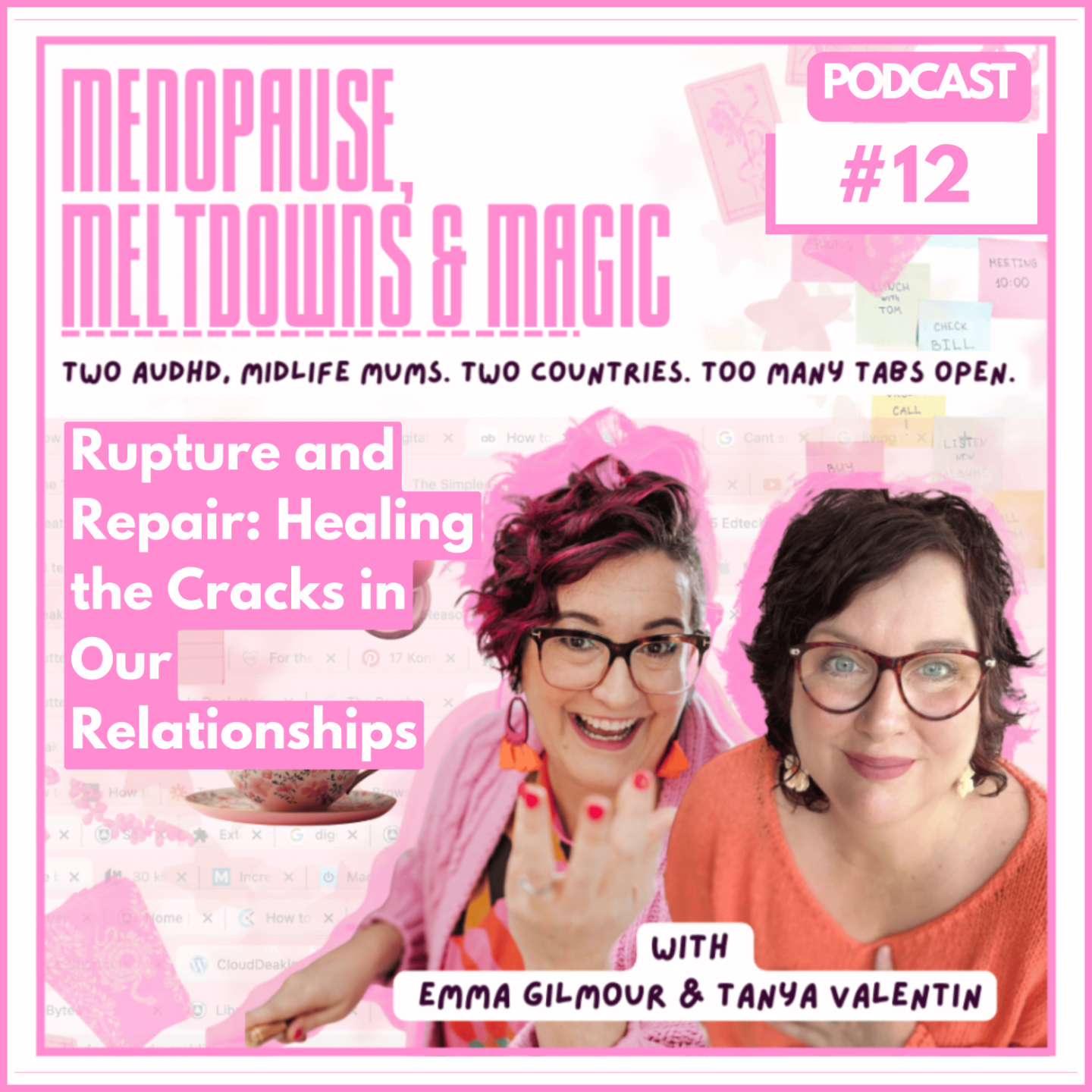
EPISODE 12
Rupture and Repair: Healing the Cracks in Our Relationships
Most of us grew up believing that a good relationship never has disagreements, conflict, or angry words.
In this episode, Tanya and Emma sit with the opposite idea: that rupture is inevitable, and the real skill we were never taught is repair.
LISTEN NOWShow Notes
Episode 12
Most of us grew up believing that a good relationship never has disagreements, conflict, or angry words.
In this episode, Tanya and Emma sit with the opposite idea: that rupture is inevitable, and the real skill we were never taught is repair.
Together they trace how their families of origin handled conflict (mostly by not handling it at all), why saying sorry to your own children can feel like breaking a generational rule, and how becoming the first generation to actually apologise reshapes the relationship on both sides.
The conversation moves from parenting into perimenopause, masking and unmasking, and the friendships and family ties that do not survive us becoming more honest about our needs. It closes with a set of practical strategies for the relationships we cannot walk away from and a reminder that a relationship which can survive rupture and repair is stronger for it.In This Episode
- Why rupture and repair is the topic, and how it kept showing up everywhere this week
- Growing up where adults had the final say and feelings were not up for discussion
- The myth that parents must know everything and never make mistakes
- Being the first generation in the family to say sorry to their children, and meaning it
- The shame wired into asking for what you need: “don't be so needy”
- A therapist's reframe: would you take offence if your own child told you that you hurt them?
- What it looked like when their children, post-burnout, told them everything that had hurt
- ADHD, executive functioning, and the “why can't you just do the thing” spiral
- How it took their children collapsing into burnout for the pattern to become visible
- Why the absence of repair hurts more than the original rupture
- Being judged as a parent by how “well-behaved” your children are in public
- Practical strategies for hard family visits: time-boxing, radical acceptance, and taking breaks
- Glennon Doyle's Untamed and the “leave your fear at the door” family boundary
- Naming family culture rules in advance, including no commentary on bodies
- Fawning, courage, and finding the words in the moment
- The core ingredient of repair: holding two truths (multiplicity) at once.
Resources & Mentions
Untamed by Glennon Doyle — referenced for the “leave your fear at the door” boundary with visitors
Magic Moments (Glimmers)
Tanya - Ordering dinner-plate-sized dahlia bulbs and getting anticipatory joy from the wait
Emma - Buying a trans and LGBTIQ+ ally pin that says “you are safe with me”
If you are a parent of a neurodivergent child in burnout and you would like something to hold you while you hold everyone else, download the free 10 Tiny Anchors Journey
If you are a woman who is questioning your relationship with alcohol, explore Emma's membership: https://www.hoperisingcoaching.com/bethelighthouse


Transcript
Tanya (00:00.536)
Hello and welcome everybody! Let me just get Tanya and the Menopause Meltdowns and Magic potty on to join us.
Then I might have to sort my desk out.
Tanya (00:30.133)
Yay.
Yay. Oop. There's my silly cat. Let's move you. There. Hello everybody. Now let me try Tanya again. Tanya.
Tanya (00:54.776)
This right.
Tanya (01:06.062)
Hello and welcome. I'm having a death malfunction.
Tanya (01:13.198)
Today Tanya and I are planning. so she's unable to join. We will try again.
Da da da
Tanya (01:32.174)
Today we're going to talk about rupture and repair, which is a really exciting subject to talk about. And funny enough, probably because I've been thinking about it and talking about it, and probably not funny enough at all. The internet's been feeding me some really good content on rupture and repair. And I'm just fish fixing my desk because I've got one of those adjustable desks. You can just see my tummy. And
At the moment it's stuck on down. So I might have to be like a mini person and do it on my knees.
Try one more time.
So it's kind of an interesting one really I think because I know certainly for my family of origin and I think in a lot of people's family of origin in our generation, that's so weird. Let's try it a different way.
Tanya (02:36.566)
I'll get turned you on.
Tanya (02:42.2)
The the concept
Yeah. There we go. Hello. Hello, how are ya? Good, good. I've just been trying to get on. I keep on seeing your little invite and I click on it and it doesn't it doesn't let me do it, so Well, I'm kneeling like a weird little munchkin 'cause I can't get my desk to go off.
I was like doot doot doot.
How are you doing? I'm doing okay. Yourself? Yeah, good, thank you. Good. Apart from my silly desk thing. but I might just leave it now and just be a small person. Sit on the floor. What's that? Sit on the floor. Yeah, that's what I was thinking. I'll just sit on the floor, see how it goes. I might shut my door though actually. yes, so I was just saying we were gonna talk about rupture and repair, which is a cool subject, I think.
To talk about I've been seeing lots of things in my feed this week. I think I was like, surprising me, but of course it's not surprising me because I'm talking about it. And so of course Yeah. Sending you sending you content to interested in it. I'm like, wow, this is amazing. Such serendipity, but no. but yeah, I
Tanya (04:11.244)
I know we've mentioned it a couple of times in our conversations previously. But I think I mean certainly in my family, my my family of origin is quite a new concept. I don't know about you. Yeah. I think it's just maybe that generation, right? Like where adults just had the final say.
you had to just do what the adults around you told you to do. Yeah. If your feelings were hurt or you were, you know, upset about something, then I I don't know about you, but often got like, Well, I'll just give you something to cry about. Yeah. and it certainly like was just like this affront to the to the grown ups around you if you were upset with
something that they told you to do. Yeah. so I mean I know the whole thing, the whole this whole episode is not about that, but I f I feel like if you grow up with that and also this idea that mistakes are not safe to make. Yeah. it can really make that sort of idea of rupture and repair really difficult because you didn't have a lot of example of it or a lot of
practice of doing it w when when you were a child because it wasn't really modelled to you. No. Except for, you know, say sorry to your sister or yeah, like this forced sort of like begrudging sorry. Yes. Yeah. Yeah.
And I think as well, you know, also because our parents also have their parents who would have probably been similar or if not more so. Yeah. That I think also there's a vulnerability, isn't there, in when you're f you know, when you are, you know, perhaps you've got your own trauma, you know, admitting that you're wrong, admitting that you made a mistake. And I think that that can be beyond
Tanya (06:38.808)
Some people sometimes, you know. Just can't be on
And I think that's when you kind of get into that whole idea of, Well, you know
Some people aren't capable of it. And and and and then how do you deal with that? So there's all these different things. There's like how we are with our children, how we are with our families, and then what do we do also when people can't come to the table? Like how do you how do you manage that? It's like a Yeah. it's another another piece of the pie because there are
There are ways to manage it also if you can't get the repair, but it's about kind of protecting yourself a little bit from the sort of impact of not being
seen or held, you know, by and grieving, you know, the fact that the person who was you would hope to be able to see and hold you can't. Yeah. Yeah. And I think, you know, the way that I see it sometimes with with parents, like my parents or maybe their parents, is that I think we've we've some we've moved a little bit away from this, but I still see it a lot in parenting spaces.
Tanya (07:59.412)
in that there's this idea that parents need to know everything. Yeah. Right? You know how you need to know how to fix everything. You need to know how to solve everything. you're not allowed to make any mistakes in parenting with your children. I mean and then if you ha ask for help or you make a mistake, you've create you've sort of
like made this huge mortal error that can't be undone, right? And then that kinda makes you feel very
Like very vulnerable. Yeah. Yeah, right. I don't know about you, but when I grew up parents were still actively spanking their children. Yeah, yeah. It was you know, I mean, I know it still happens in other countries. It doesn't happen here in New Zealand anymore. I don't I don't think it happens in Australia. It's not supposed to, but I think it does behind closed doors. Yeah. I remember
You know, we had friends who I thought were quite kind of woke people and they're still dead with their kids, which I know isn't you know, it's not legal. Yeah. And quite surprising really, but Yeah. Yeah. So we can just you know, there's l there's there can be like a lot that can sort of be sitting behind us. Yeah. And I know when like
the idea of saying sorry to my children or you know I probably is sort of like the first generation of parents in my family who have actually said sorry to their children. Yeah.
Tanya (09:54.452)
And felt okay with that. Yeah. but I don't know. Yeah, it's just can sometimes be something that's really hard for parents to do. And it's also something that's really hard for us to do in our other relationships as well. definitely. Definitely. Across all the relationships, I think it's and I and I definitely think for me it was best part of my upbringing was that we didn't it's kind of like
I I I I hear phrases like dwell in the past or hold a grudge or you know, that can be the interpretation of wanting to discuss something that's happened. Yeah. Rather than just pretend it hasn't happened. it can seem like and and and I can see now, you know, reflecting on it, and I think I put this in the post last night when I was thinking about it, why so many of us felt that.
we were too much when we like might have said something because that's that sort of kind of reaction would be it's almost like you should be a bit ashamed 'cause you're sort of
Tanya (11:12.044)
it I kind of feel like it's a little bit like attached to those sort of ideas of of laziness and putting up and shutting up and you know that you're you're you're you're making it all about you, you're making a big fuss, you're Yeah. Yeah. And so of course then we interpret a bit of shame, don't we, when we're like, I want to say this doesn't feel right for me and I'm not happy, but if I do that
then I'm gonna be made to feel a bit ashamed for doing so. And that feels really unsafe. Yeah, it's like don't be so needy. Yeah. Yeah. Yeah. Come on. Yeah. Yeah. And I do remember trying to have those kind of conversations at the dinner table and stuff like that. As a sort of young adult and not getting not getting a great response. Yeah.
Just 'cause I think wasn't part of the it was kind of seen as a weird thing to do. I think it was like, Yeah, why are you still holding on to what happened yesterday? Where Yeah. You know, and and I think sometimes with us like I know for myself, I can't speak for anybody else, but I know for myself. Sometimes it takes me a while to process. Yes. Like a hurt or something that happened, and like I might not have the words or even the capacity in the
moment to process what's happening. It'll only be like later in the week or a few days later, where it finally sort of like lands in my body. Yeah. Or I'm able to like, yeah, that was actually wrong. Or or if I'm slight if I've hurt somebody else, sometimes it takes me a while to to process that enough to then go to that person and make a repair. Yeah.
It is a funny thing though, because I I was I was talking to my therapist about it last week and she was saying, and it felt so strange when she said this, she was like because I was you know, I think as adults we make a lot of accommodations for other people, you know, that we're in relationship, be it husbands, be it parents, be it friends. We can cognitively kind of
Tanya (13:36.48)
explain away people's bad behaviour. they do this because they had this childhood, or they do this because they were that was a bid for attention. Yeah. Misguided but a bid for attention. but when I was talking about therapist, she she makes a good point. I thought she was like, What if your children came to you and said, Mom, you've done something and it really hurt me.
Would you take offence? And I'm like, I just don't think I would. Like maybe I would have in the past. But where I am right now, I don't think I would. I'd be I'd be mortified actually. Yeah. I think if I I th I'd be like, my goodness, I didn't I didn't realise. But I think that might be more since I've done some of the work that I've done.
I I'm exactly the same. Like if I think about myself like ten years ago. Yeah. I I so desperately wanted to be a good parent. Yeah. And or be seen as a good parent. Yeah. And to not hurt my children and that any sort of evidence to the contrary would just it would
really trigger my R S D and then I would like r really go into defensive mode rather than hearing my children and what they were saying. Yeah. And this the sad thing is is that it took like my children going into burnout. Like it took that sort of crisis in our family for me to actually fully
like get it. Yeah. I and i I feel I I still feel really ashamed about it because, you know, it took it took that to I suppose prompt me to do the work to kind of figure out what was going on behind that. And I remember one of my kids' recovery, a lot of it like t you know, after the crisis had ended and you know, we were sort of
Tanya (16:01.032)
moving more into like them sort of experiencing the world again outside of our home. A lot of it was just me sitting down with them and them telling me all the things I'd done. Right, yeah. That hurt them. That must have been really hard. it was so hard. yeah. And me just like listening and not reacting. Yeah. And just kind of like
really taking it in and sitting with it and just saying, I'm just so sorry. Yeah. I I never meant to make you feel that way. and you know, if I if I did, you know, I am just so sorry. And you know, it's it's such a hard place to be, but I also feel like going through that process made me a better parent.
Yeah. Because before I would have reac reacted in a very like reactive, defensive way and and then I would have been dismissing their experience. I would have been like closing myself off to them. Yeah. And now they know that they can come and talk to me about that and I'm going to be receptive to it. But it was such a huge shift and it was such a painful lesson to learn.
Yeah. I I I I agree and I for for us I think the there was just a total lack of awareness in my brain head that things were any different than how I thought they were. And all I thought was that we were just a bit shit at doing the things that everyone else seemed to be able to do so easily.
And I'd get more and more cross with the children. Why can't you do this? I and I get like a reason like 'cause you know, when kids have got like executive functioning issues and like I I'm now as the same as a kid still am as an adult. My ADHD's terrible with my executive functioning is like It used to drive me mad because I'd go in and I'd be like 'cause you know that sort of like idea when you're with
Tanya (18:25.514)
adults, right? That you've got you have something, you give it to the other person, then they've got it, off they go and it's come off you. Like you're no longer holding it. And I'd go into my kids' pleasure. Right, come on. There you go, done. Off I'd go on my merry way. Come back. And I'd get so what's the matter I'd like they were doing it to me.
Yeah. You know, I've given you this it's not mine anymore. Why haven't you done it? And again, you know, it's embarrassing and you know, I'm I'm laughing because it's like I don't know what else to do because it's you know i i it's very difficult in our society, isn't it, for for for for people to understand the inability to function in the way that
and this is I mean, this for us was probably before everybody went into burnout, the beginning of the realisation that things weren't as they were in a neurotypical family, but still not really knowing because not knowing anything about not being neurotypical because you know, when you're in the pond, you think you're a fish like everyone else. You're just a shit fish.
It's like And of course I don't think that now. I think we're different. But it's just like you're at the time you're like, but everybody else is doing this and I can't why can't my children put their shoes on and get out the door? Why is it so why does it feel so hard? Like I remember in COVID and everyone had was like posting all these
And we've got all these chore charts and I like, Well, I'll try I'll try a ch
Tanya (20:30.158)
Absolutely. But you know, we get quite cross about it. These poor children, plus some little hearts. and it was only really like I don't even know that my kids took to sat me down and told me what I did wrong. It was more they collapsed and, you know, became, you know, very mentally unwell.
through probably trying to fawn and achieve things and not being able to like not being able to just not being possible, you know. Yeah. Yeah. And you know hold those those younger versions of ourselves with so much grace and compassion, right? We were just doing the best that we could. That's right. And we were doing the same to ourselves. That's the other thing. Yeah. Like
All this stuff I do to my kids, I do to myself as well. That's great. Yeah. Why can't I do this? Why ca why am I so exhausted? Why why can't I function like everybody else? Yeah. Yeah. Yeah. Yeah. And it's such a
It's such a is it it it's such an interesting thing, I think, when you I think there's a little there's something about rupture and repair as well, I think that the rupture
Without the repair.
Tanya (22:08.416)
It's almost the fact that we can't repair that feels more painful than the rupture in the first place. It's that sort of inability to see another human being in their pain. You know what I mean? Yeah. Well, I I love that real that you sent me when we were talking about this about, you know, changing your perception with the repair being that you have to change your perception from yourself.
Yeah. To the other person and being able to sit in the discomfort of the hurt that you caused them. Yeah. Like that was just like a real oof, right? But yeah. But that's true. You know, we're so we we feel so uncomfortable with other people's pain or their anger or their sadness.
And we try so hard to move away from it as quick as possible. Yeah. That and you know, it it just it creates such a feeling of not being safe. Yeah. And then so, you know, a lot of us, and I know I am, you know, certainly guilty of this. We we want to go in there, we want to fix things as quickly as possible to avoid the really hard feeling. Yeah.
And we make even though we're trying to apologize to them, we're still making it all about us. Yeah. And not about that the person we hurt in their experience. Yeah. Yeah. It's
It's a it's a very interesting one because it requires
Tanya (23:56.366)
not about anything to do with it. Regardless, it actually doesn't matter even whether the other person we think the other person's right or wrong. It's not even about that. No. It's like understanding that they're hurting and being able to hold their hurt. You know? Yeah. And that's the
without it being it means something about me. Yeah. Which I think when we think about like, you know, families of old or the old way of being, there was that so much enmeshment between parents and children that it really did feel like it was
that the people were doing us harm because there's so unbounded between, you know, the the children extension of the parent and how the children were perceived as why they were so particular. Because they f thought that it meant something about them if their children were perceived badly. And I think I think that's still very much alive and kicking in our current culture, right? I agree. I agree. I agree.
how how parents are, you are judged by how well your children are doing, how well behaved they are, how well adjusted they are, how successful they are, you know. And yeah, I still have people say to me, because one of my children is doing like this really difficult degree at university.
you must be so proud of them. Look at you. You did such a great job. Yeah. you know? And it's like, well, actually No. That's nothing to do with me that they're going to go and do that. Yeah You know, they got sure, I supported them, but they did all the work to get themselves there. It's You're right. You're right. It's nothing really to do with with me. No. And it's also I think when you are going through difficulties with your children.
Tanya (26:07.37)
one of the things that makes it so difficult to interact with other people who are not going through difficulties with their children. Because that sense of my children are independent and capable and competent because is a reflection of me and people kinda like puff up their chests a little bit and it can feel really hard when you're really struggling with you know getting out of bed. Yeah. Yeah. You know, or
Or, you know, like we still to some degree judge parents for like how polite their children are or how well behaved they are in public, you know. Yeah. And and there's not a lot of understanding around like dysregulation and sensory overwhelm and that behaviour isn't necessarily a child who wants to do you know
bad things. It's just it's a it's a pick it's external window into the distress or how the person's feeling on the inside, how their child's feeling on the inside. And yeah. But there is still this huge judgment for parents on that if their children can't be polite in public or say please and thank you. That's right.
And it was interesting actually was reading because there's been all lots of big changes here in terms of like disability funding and stuff like that. And now with the changes that they're bringing in, it's all about parental education. Here you go, here's a parenting course. yes, of course, because you know Excellent. But again, it's that same thing, isn't it? There's
Whatever's happening with your children is a reflection of, you know, your ability to parent. It's i you know, like if I parented right then maybe my child wouldn't be disabled.
Tanya (28:14.822)
What? my goodness. Yeah. It's just that, you know, that thinking, right? It's like It's really ableist, It is. Because like I would much rather, you know, like, well, what are you doing to spend money on like
Fixing the systems that make our children feel more disabled, right? Yeah, yeah. And just most all of the systems. I was remembering this morning going with Daisy when she had was really, really sick, like was really not in a good place. And we went to the Royal Children's Hospital and we fought and fought and fought to get a counselor appointment. It was so hard to get. And all the counselor did was she spent the hour session
Going through a local psychology company's website and getting Daisy to pick out which of the psychologists on that website who I'd already knew were completely full and there was no space. Yeah. So getting spending it time with her and getting her to choose the one that she liked the most without like realizing that I would have already done all of that and realised it was just such a waste of
And it got her hopes up that she might be able to have one of those people, but she couldn't. And it was just like a waste of time, which could have been spent having a really like relationally safe chat with her, rather than just trying to kind of fob us off to somewhere else, as if there was like a problem with us rather than that we were just human beings, you know, looking for someone to say you're okay. It's okay.
Yeah. Yeah. I'm so sorry to hear that, you know. Like I we've had a very similar experience with a person here, through one of our, you know, the the CAM system here, who spent like six appointments really just digging into one of my children's like all their trauma, all their like their their hurty bits.
Tanya (30:28.992)
And then called us in and said, no, this is just like it's too complex, it's too much, we can't deal with it. Here's someone else that you need to phone and so now we're on the waiting list for that, you know? And it's like Yeah, it really just makes our children feel just like no one's listening or that you know, or they're not important or they're they're too much, you know, that sort of feeling again.
Yeah. Yeah. And even, you know, when you do see people, they don't really take in everything that's happening as well, you know, so you can end up seeing somebody for six appointment the six appointments. Yes. Six appointments is just nonsense as well, right? You can't have a relationship with somebody in six appointments. And the children need relational safety. Yeah. Take six appointments to feel probably like you can talk to somebody.
Yeah. Yeah. It's Yeah. And you know, it's and then like for us as parents, we we're on we're sort of there trying to have to make repairs with our children. Yeah. For that situation. Yeah. Because, you know, they've come from that situation where that person should have been able to be trusted. Yeah.
their hearts are broken because of it. They've their self esteem is like so low because that person by default said like you're too much for me to have to deal with. Yeah. And then and then we're like trying to do the repair to their self esteem, to their That's been caused by another grown adult. Yeah. Who should be who should know better. Yeah. Yeah.
Yeah. And also I like listening sometimes as well, you know, those adults, what they say. I remember going into, you know, really quite neuroaffirming practices with psychiatrists and stuff, where, you know, they should know what autistic burnout is, but they treat it like depression. And you know, and then you know, telling your your child in burnout that she needs to be exercising more and getting out and getting some fresh.
Tanya (32:56.366)
Like that scope. Yeah. And so then again putting it all back on the child or the parent, you're not good enough. This is the reason why this is happening to you. If you only it's a bit like they do to us as p parents' mothers, you know, when they go, you know, if you how's your self care? Yes. Yeah. Yeah.
And then, you know, but but nothing is said or done to address the fact that, you know, you're constantly feeling like you're in an an anticipatory waiting mode, waiting for the next hard thing to happen. that just even if you have the actual physical time. Yeah. You that time is not time spent
relaxing or you know, doing something for yourself because your mind is continuously going and in hyper vigilance thinking, when am I going to when's the next thing that I'm going to have to jump into and do? What's the next emergency I'm going to have to be like reactive for? Yeah, yeah, yeah. Totally. Totally. It's
Tanya (34:22.006)
It's a difficult environment because it does mean as well that we're more activated too, right? So in reality we're probably more likely to cause ruptures. Yeah. Because we're stressed. Yeah. Yeah. And I think, you know, part of every relationship, like we you know, l a lot of us who sort of
led to believe that, you know, you're not supposed to argue, you're not supposed to fight. I mean I don't think I ever observed my parents ever having an argument with each other. So, you know, I'd never really when I when I got married and and there were lots of ruptures and lots of arguments, I thought, I'm there's something wrong with me because I can't achieve this level of harmony that my
parents had. Of course they probably they had arguments we just never saw them. Yeah. and also, you know, then if you don't witness and I'm not like saying hey, you should just like have these full on Barnies in front of your children, but I don't think if you if if you don't w witness any sort of like rupt. Yeah. And the repair that comes after that, it can be very difficult to know what to do in those situations.
You know, so definitely and then you know, and then you sort of get the whole I'm sorry that I'm sorry you feel that way rather than Which isn't really an apology. Which is really like you dicket. Yeah. Or you know I'm sorry but and then dumping in with with your justification on why you did XYZ.
Yeah, yeah, exactly, exactly. It's
Tanya (36:22.22)
I think as well for particularly I think as you as we get older and I think going through the perimenopause, menopause
Tanya (36:36.334)
Period I I don't know about you, but for me
Some of the things I used to be able to suppress and pretend were okay, I'm less able to now. 100%. Yeah. And I think perhaps in relationship I might hi Susie. Good to see you. I was thinking i i in in relationship I I perhaps was able to put up with things a lot more and be less, you know.
stringent in you know saying hey I'm hurt and I don't want to just let this I don't want to pretend this didn't happen. I I don't seem to be able to do that as much anymore. You know what I mean? I think it's like a but I do think that when we do have the conversations even if they're really hard and they are really hard, right?
They're hard because we hate like all of us hate confrontation. No one wants to be sat there and you don't know how the other person's gonna react and sometimes it can be really bad. You know, whether whichever side you're on, you know. Yeah. There's a potential for and the way our brains go, we always go to worst case scenario, right? There's a potential for I remember when when I was when I first started having difficult conversations with my husband.
Mm-hmm. It was part of the reason I used to drink was so that I didn't have to have difficult conversations because I thought, well, if we have a difficult conversation, that probably means that we'll get divorced. Yeah. Cause that's where the brain goes. absolutely. Whereas actually, you know, a bit like what you were saying with the kids, it's like I always think I think I pretty much can s put my hand on my heart and say that every relationship
Tanya (38:37.346)
that you're able to rupture and repair is a better relationship for having been ruptured and repaired than it was prior. I haven't had a situation where it hasn't been. You so far. And and I think also, you know, there is a definite authenticity to relationships where you can do that. Yeah. And in if you are in a relationship that doesn't
survive rapturing and repairing that it probably was yeah the right relationship for you to be in. Yeah. And that's I mean that I'm saying that in a way and thinking like the amount of grief that can come with that. a hundred percent. but and this come with a lot of like a lot of living through s through shit, right? Yeah. But
I and I think this is probably a perimenopause thing too. But I at the moment, like the way that I feel about life is that if I have to be in a relationship where I'm half half myself. Yeah. Or I'm not allowed to express my needs. Yeah. Then is that the right relationship for me to be in? Because I don't think our relationships should cost us ourselves. No.
And but the and the c other side to that though is that that can end up with us not having very many people. Yeah. Because a lot of relationships we've gone into as masked people, and when we unmask it the relationship's not there, not what we thought it was. You know what I mean? Yeah. It's and it can be quite especially I think for the autistic experience, really autistic female assigned at birth humans.
You know, because we've masked when we've gone into a lot of our friendships, and then suddenly we're like you know, do the big reveal. Well, this is me. Hello. Hello, ladybugs, the lovely ladybugs. then suddenly the they people disappear, and it's that that's really hard, I think, because they're because of the existential loneliness that we talked about when we talked about CPTSD.
Tanya (41:04.918)
Yeah. That existential loneliness and suddenly it's like, well, it when I unmask and reveal and then they don't stick around and yes the cognitive part of our brains like well, you they weren't for us, but our little heart and soul's going, But I wish they big I know, I know. It it's such a hard thing, right?
Tanya (41:35.226)
And I feel like the more I know myself, the more I'm able to call in relationships that
are better for me now. Like I probably don't have a lot of relationships from before I I found out about my neurodivergence. I probably have like I've got this really one good friend and we've probably been we'll probably be friends until we Yeah. yeah, until we're very old ladies. And funnily enough, she's realised that she is she's ADHD too.
Yeah, yeah. and so we have a lot of conversations around that kind of of thing. But
feel like me getting really honest about what I need in a relationship and and also just learning to be honest about that with people has allowed me to have people in my life like like for example you and you know other neurodivergent people who I can actually have some of these really deep and complex
And unmasked and quirky, weird conversations and I know that all of me is welcome in their conversations in that relationship. Yes. Yes. And also still acknowledging, you know, sometimes the hurt of realizing when a relationship isn't
Tanya (43:19.904)
what you thought it was, you know what I mean? It's like one hundred percent. Like I think it's it's kinda like you can't have like one like without the other, right? Yeah. Yeah. You know, there's whenever we let go of something, there is there is a period of grieving that happens, there is hurt that comes up. It's it's not like a it's not like a flippant sort of like no no whatever. it it can be really
hard like a hard growing experience. Yeah. and if you think about like, you know, when when you're a a kid and your body's growing, you have all those growing pains. Yeah. To me it's almost feels like that sometimes with like us growing into who we are as you know, unmasked autistic human beings, right? Yeah.
There's a lot of pain that goes with a lot of pain. There's a lot of pain. But it's good like you say, it's good because it really isn't where we want to be wasting like our energy if we are still trying to get, you know, people who aren't for us. Yeah. To be for us. There's a there's a pulling to that. There's an energy loss, right? Yeah. And a performance required.
I think one of the things about having limited capacity as well. Yeah. Is that you you kinda end up having having less capacity for bullshit. Yeah. Because you just don't you just don't have the energy for it. No. No. Yeah. Yeah, I agree. And and that can be like a reality that hurts sometimes. Yeah.
And and I also think it's a really important thing for us to learn about like
Tanya (45:21.76)
Understanding our capacity and been able to honour that. Yeah, I agree. I agree. I think so too. And I think it sometimes as well we've got there's there's certain relationships that we might feel, I I need to stay in relationship with this person even though they might not be that we might not have the capacity to be who we want them to be, right? Yeah. Like a parent or
I don't know, somebody a sibling or something. And you might know it, you know, very reasonably might decide that that's not for you. But also you may decide that that is. And I was I was reading recently about, you know, what some of the strategies around that, which I thought was quite interesting. And it was quite interesting how relative it is to was was to kind of how we are with ourselves and with feelings. And it was again talking about becoming the observer.
Which I thought was really interesting. It was like so taking yourself like you would do, say for example, if we're in a you know, we're having a big experience, we know that sometimes when we can be the observer rather than being in the storm. And that's not always possible. So there's a person who's very often in the storm. But you know what I mean? It's it's like if we can absorb, if we can say, Okay, well, this is this the relationship, I'm not gonna, you know, I'm not gonna not be myself.
And I'm not gonna, you know, state my needs or be needy to the other person, but I'm gonna let my need me stating my needs be enough. I don't require them taking away that sort of like trying to control the end bit, which is where they respond back to you. Yeah. It's like letting it be okay that you've put your thing there and however they choose to come back with it. And I guess this is probably.
you know, easier said than done. one hundred percent. And I see it in so many different ways. You know, like and to me it goes right back to my childhood where, you know, parents would like put tell you to do something and then you weren't allowed to be upset about the thing that they've told you to do. Yeah. and I th I see this like in parenting as well. Like we we put down a boundary with our children and then
Tanya (47:41.804)
We try to control their feelings about our boundary and we do that in friendships as well and other relationships. Like we only get to own the part where we put down our boundary or we put say our thing or express our need. We don't get to control how that's going to be perceived or how the other person's gonna feel about it or yeah. Right.
I thought that was quite interesting because I was like, I d I don't know how you deal with this. Like, do you just go would do you have to go no contact or do you have to and that it was like, well not really, you just change your expectations. It's like, well, this is what this person can do and am I happy to be in relationship with a person who can just do that much? And and knowing that you're being true to yourself, you don't have to adjust yourself.
But just know that it's not always going to be received the way that you want it to be received. So Yeah. Yeah. And and also just acknowledging that us as humans, we we want to be liked. Can you repeat that? I couldn't hear you, sorry. I said us as humans, we want to be liked. We want people to accept us, right? But we want we don't want people to think badly of us. And you know the idea of losing that
can sometimes feel like like worse than death sometimes when you know so it's not an easy thing to do. You know, something some ways that I deal with relationships that I have with people that perhaps are a bit h harder to get on with in my life is rather than limiting contact with them. Living I lim you know, not being in contact with them is I if I am going to go see them
I I prepare myself ahead of time and I'm like, okay, this is this is only gonna be an hour or this is going to be two hours. And
Tanya (49:49.678)
And I'm going to just accept that person for who they are right now. Like like practice radical acceptance. Yeah. And
Tanya (49:59.874)
Yeah, and then kind of almost just put some emotional barriers like or boundaries around myself for that sort of like two or three hours. Because sometimes we just can't change people. And they're gonna say things that are hurtful. Yeah. They're going to, you know, be
you know, they're not going to be have awareness of how they how they speak affects other people. Yeah. And so sometimes we just have to go into it with that sort of that knowledge of, okay, this is how this person is. no matter what they say, I'm still going to be okay. Yeah. And and there's a limited time frame for this, right?
I'm a two hour box person. I'm like, Yeah. You know, I'm only gonna be there for a couple of hours. And then and then also sometimes I will take some little breaks. I will find like moments to kind of go outside and just remind myself that I'm okay in that situation. you know, take take myself to the bathroom and just spend a bit of time there, like running cold water over my wrists. Yeah. Just like
You know, taking care of myself through that. That's a huge one. Huge, I think.
Tanya (51:34.208)
And because the truth is we're not always going to be in situations that make us feel safe or make us feel comfortable. No. No. Absolutely.
It is tricky though, isn't it, when it comes to our kids and who we allow to have that, you know, kind of I always remember reading Glenn Doyle's Untamed. Did she read that? I love their book. Yeah. And she talks about, you know, if you coming into our house, you don't bring that fear with you. Yeah. You leave your for at fear at the door. It's like a moat with a drawbridge. If you come into our house, you don't bring that in here. Yeah. Otherwise you have to go outside.
And I thought that was so good. I I love that. Especially for us trans kids, you know. Yeah. I I'm just saying that, you know, like I don't have I don't have any tolerance for people who come into my home and like do not accept that my child is trans. And also don't for people who don't accept that my children are autistic as well. Same. And that might and that perhaps they're not gonna be able to sit at the dining room table and say
Yeah. With still bottoms on the seat. Yeah. Or that they might just say hello and then go to their bedroom and and be there and and not do the hugs and all that kind of stuff. Yeah. You know, and if if you you know, if the most of the people in my family they don't feel offended by that, but you know, that's just the way things are because I I I can't
My children have a right to feel comfortable and safe in their own home. I agree. And I also don't think there's anything wrong with kind of being like these other things we don't do in our home before somebody comes to visit. Like especially if you've got relatives coming to stay. Like you know, commenting on size of pupils bodies is not acceptable in my house. Yeah. And so I just need you to know that that's not part of our family culture. We don't go
Tanya (53:43.438)
Aren't you lovely and slim? Which is being being a household full of people with eating disorders. Not helpful. Yeah, no, no, not helpful at all. And just that sort of thing, I think. It's it's okay. I think often people sometimes it's it's people don't realise.
That they say things and they're not gonna be they're not gonna land well. So y sometimes it's okay, I think, just like let people know. yeah. Yeah. And whether they take offence or not is up to them, I guess. Well yeah, that's that's the thing, right?
You know, that
It's sometimes choosing between like the harm that somebody's comments do to you know, say your children who are incredibly vulnerable. Yeah. Or the idea of hurting the other person's feelings. Yeah. Like which of those are the things that I can live with well. Yeah. Like I'm not going to live with
the harm that somebody's comments are gonna make to my children that might potentially send send them into like crisis mode or affect their mental health negatively. And that's such a culture change though, isn't it, from the generation before? And I've had to do so much work on myself with because
Tanya (55:24.75)
You know, me just saying that, you know, sounds like really, you know, it's just so easy for me to do that. But no, like, you know, as you know, I'm a massive fauner. Yeah. So for me to like be able to actually have the courage. Yeah. Or the not really the courage, the regulation in myself, the awareness that I'm wanting to fawn in this situation to feel safe around this person that's in my home. Yeah. And
being okay, feeling safe enough in myself to be able to to say that. Yeah. Yeah. I think it is courage as well, because I think for those of us who have, you know, it wasn't safe enough for us as, you know, young people to say this isn't okay, there's still that little part of us that's like they might get mad, they might reject me, they might
So there's a little bit of like I think there is some courage to it as well to do it. absolutely. And I think it's so much easier for me to find the courage to speak up for my children than of course for myself. For sure, for sure, for sure. I agree. I agree. And you know, we also know all the times that we weren't able to and have to forgive ourselves for those two. Yes, because there have been times I've Many, many times.
Yeah, you know, and I've re I have really had to sit with myself through some with some of that stuff. Yeah, same. Yeah. Same, same. And just in terms of kind of repair, what for you is the kind of core ingredients? What do you think the most important thing is? I think being able to as w kind of like we mentioned earlier in in our conversation,
Like
Tanya (57:23.608)
think the thing that's made it easier for me because like you know it to me repair is being able to put aside put aside your own feelings about it and actually being able to be to actively listen and be with the other person yeah is in the dis in the pain or the discomfort that you cause them. Yes. And not to feel defensive. Yeah.
What has really helped me is that like the whole sort of idea of multiplicity. Of what so could you repeat that? the whole idea of multiplicity, you know, like two things being true at once. Two things being true at once. Like like so I can have said something and not meant to hurt somebody or meant to be offended, meant to offend them. Or I could have said something and been highly dysregulated and hurt somebody.
Yeah. That's one reality, right? Yeah. But it doesn't it doesn't wipe out that I hurt the other person. Yeah. So being able to like, okay, yes, that was my reality, this is why I did it, and I still hurt this other person by what I said and what I did. Yeah. And and
And I can hold both of those realities. Yeah. Hundred percent. Yeah. That's like the the biggest thing for me when it comes to repair. Yeah. I think so too. I think so too. It's really that sort of like ho containing self a little bit and going, Okay, just like let's let this let's be with this person rather than be in our own hut and all the other stuff, you know? Yeah. Yeah.
Yeah. A beautiful process if we can do it, you know what I mean? It's like this it's so important, I think. It is. And, you know, also just holding space for sometimes it's easier to do it than other times. You know, sometimes we are in the space where we can hold that multiplicity, where we can hold the hurt of others, and then sometimes sometimes we're not. And sometimes we're not. Sometimes our capacity is really low, we're in a bad place and
Tanya (59:47.202)
Yeah. And it's it's a lot harder to do that. Yeah, yeah, exactly. Our messy humanness, right? Yeah, yes.
Do you want to share a glimmer? Was your did you have a lovely glimmer today? I do. I do I I ordered no it's kind of like it's an anticipatory glimmer. I ordered some dahlia bulbs for my for my garden and I'm just really excited to receive them. some of them are like those dinner plate sized dahlias. I love them. I love them too, so I'm really excited about they remind me of England having those big
Flowers so beautiful. Yeah. Exciting. How exciting.
Tanya (01:00:37.1)
Mine is a bit silly, but also quite exciting and a bit of a I got very excited because I saw an advert on Instagram for one of those like nice little ally badges and it was a really nice one and it was a trans and an LGBTIQ plus one and it said, you are safe with me and I was like, I really want to buy that and wear that around. I got very excited for that. That was my it was a it was a bit of a dopamine.
I'm buying something, but it was also like I really love that because I think the more the bus that can wear those things the safer that people feel. Hey. one hundred percent. You know. Yeah. Yeah. I know how important it is that your children do feel safe in who they are around you. So yeah. Yeah, yeah. Thank you. Thank you. It was really lovely.
Lovely smooth, you too. Lovely to chat and have a really great weekend. You too. And Susie, thank you for joining us, Treasure. It was lovely having you as well. Thank you, Susie. Bye, bye.
Work With Emma
Single intensive counselling session — $247
1 hour 30 minutes - Initial Consult
You will get: Notes, Resources, Session Recording - downloadable for 7 days post consult
We will map out your personal roadmap to finding your version of that illusive ‘take it or leave it’ relationship with alcohol. Using my 3rd Way method. This is a complete option in itself and there will be no hard sell on anything else. If you do decide to continue with any of my packages afterwards, the cost of this session comes off the price as long as you book the longer program within a month of the session.
BOOK HERE
Want a text when we go live on Instagram?
Drop your details below and we’ll send you the direct link so you can join us, ask questions and be part of the conversation in real time.
Opt out anytime.
YES! SIGN ME UP