
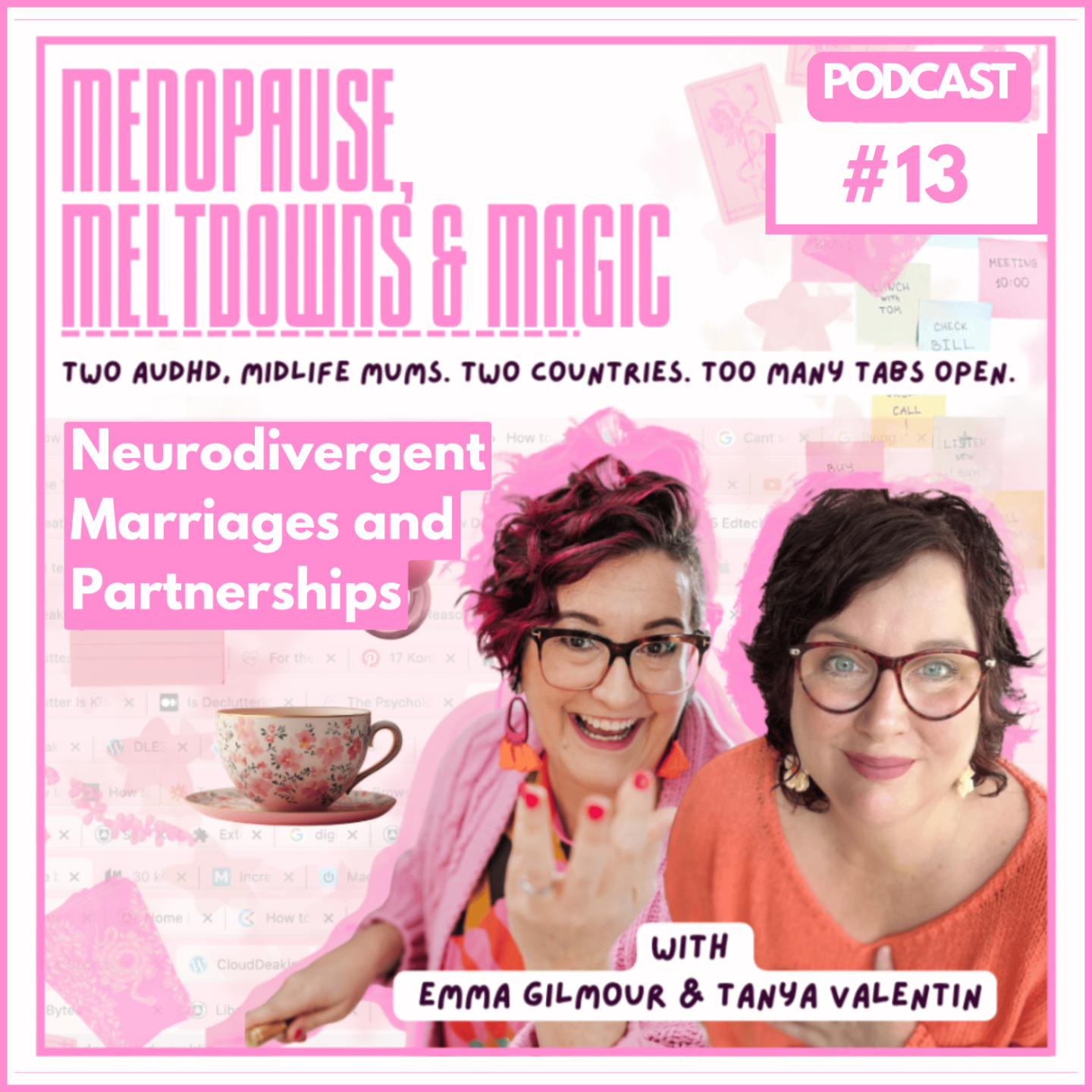
EPISODE 13
Neurodivergent Marriages and Partnerships
Tanya and Emma sit down for an honest, unscripted conversation about what happens to a marriage or partnership when one or both parents are neurodivergent, and when a child moves into burnout.
LISTEN NOWShow Notes
Episode 13
Tanya and Emma sit down for an honest, unscripted conversation about what happens to a marriage or partnership when one or both parents are neurodivergent, and when a child moves into burnout.
They talk about co-regulation, the invisible load carried by the primary caregiver, the grief of an imagined future that never arrived, and why so many parents feel trapped between their own safety and their family's survival. It is a tender, sometimes raw episode, and one both hosts say could easily have run for hours.In this episode
- The long middle of a neurodivergent marriage - Tanya reflects on her own thirty-year marriage, marriedat twenty with no idea either of them was neurodivergent, a hard decade of not knowing if they would stay together, and the slow, ongoing work of rediscovering the relationship as two neurodivergent people.
- One partner usually leads, the other catches up (or doesn't) - Parenting differently is heavily conditioned against. Often one partner takes the lead in learning new, more neuroaffirming ways and becomes the primary caregiver during a child's burnout, while the other defaults to managing finances and logistics, a split that can breed resentment and feel like judgment rather than support.
- Co-regulation quietly shifts from partner to child - Many neurodivergent couples unconsciously co-regulate each other, often without realising it's a foundation of the relationship. When children arrive, that co regulation frequently shifts onto them instead, leaving the partnership without the thing that was holding it steady.
- Financial dependency and fawning history can trap people in unsafe places - Stepping back from career to caregiver comes with a real cost: less financial independence, less agency, and more vulnerability,especially layered on top of a fawning, people-pleasing history. Both hosts hear from women, especially in school can't and PDA communities, who stay in relationships that aren't safe or fulfilling because there's no financial way out.
- The exhausting performance of the 'perfect parent' is a safety response - Pinterest parties, working-mother guilt, and the pressure to look like you have it all together aren't vanity. Tanya and Emma name these as nervous system safety responses to a deep fear of being seen asfaulty, and talk about the grief underneath it all for the imagined future and community that didn't turn out as hoped.
- It's especially hard for dads to be vulnerable or ask for help - Cultural conditioning tells men to toughen up and solve things themselves, therapy carries cost and stigma, and shame often sits underneath anger or control when a father feels powerless to fix his child'sstruggles. For Tanya, the biggest turning point in her marriage was her husband seeking outside support and the two of them doing the Tuning into Teens course together.
Mentioned in this episodeUntamed by Glennon Doyle — referenced for the 'your house is your drawbridge' concept
Tuning into Teens — the parenting course Tanya and her husband completed together
Practical Magic 2 — the film Tanya's magic moment references
Offers & further support
FREE 3-Day Alcohol Reset with Emma
22-24 September, 7:30pm AEST (replays available). Ajudgement-free space to learn tools for a take it or leave it relationship withalcohol.
The Great Aussie Alcohol Experiment with Emma
Live from 1 October, 30 days, small group coaching, 25spots only.
Tanya's free 10-Day Tiny Anchors Journey
A gentle, guided starting point for parents wanting asmall, doable anchor in the day to day of burnout recovery.


Transcript
Tanya (00:17.07)
Hello. Hello. How are ya? I'm good. I'm good. How are you? I'm fine, thank you. I've got my I've got a new phone and I it's I haven't quite got the stand at the right time.
Tanya (00:34.35)
Let's see if I can play maybe I'll have to lean it up on something. I probably should have done this before I came on. Hi, good to see you. Can you hear me properly? Because I've I'm slightly covering my microphone, I think. No, no, I can hear you properly. Okay, great. Welcome. So nice to see you. Good to see you too. Yeah. I'm on super go slow today. I'm having when it you in those days where you're just like trudging through treacle.
let me have a little a reinvite of our Mel who's looking after our podcast page. When she can't get in, I'll try and invite her again. it's being silly. This is what happened with you last week, Yeah. While I do this with Mel, do you want to introduce our subject? Yeah. So today we're going to be talking about
neurodivergent marriages or partnerships. and this is a topic that often comes up for a lot of families because it can have like it can have a big impact on on your relationship with your your your spouse, your significant other, a co parent, and you know, I know thinking back to my own like
My own relationship, my own marriage with my husband. There's so much that we've like learned since we were like we got married at like twenty. So we've been together for thirty years. And Yeah, there's just been so there. It's a long time, isn't it? It is. I mean, at n that that stage we had no idea that either of us were near an opportunity.
And like it hadn't even crossed our minds and like the sort of moving through there was like this this really hard phase for it. There was probably about what about ten years really of it that where I was like, Are we actually going to stay together? Mm-hmm. and then it sort of kinda coming out the other side and now like
Tanya (02:56.982)
rediscovering our relationship in terms of two neurodivergent people. you know, it's it's really it it's a real ride, right? that's such a great way to describe Yeah, it's like a roller coaster if I think about it. And yeah, I just I know that that when you know this comes up so much in my
on my Instagram page, it comes up in my community again and again. And yeah, so I just thought of it might would be a really good topic to talk about. And I don't know what your experience has been, just sort of off the bat, Emma. Yeah, look, I think it's a a brilliant topic and I've been writing about it a bit because what I notice is there's a s a high proportion of lone parents in our community.
Mm-hmm. Like particularly in the school can't community. I think, you know, particularly where there's strong PDA kids involved like involved, and there's so much I and we can talk about the complexity of it. and I think like I was I was researching the sort of stats around it. And there's not much actually around specifically what I'm talking about, like autistic burnout, PDA and from what I could find anyway. And
come on Emma. School can't. My brain's really slow today. I'm really sorry. I have taken my meds. They're just not functioning. It's one of those days when you find like the hairbrush in the fridge, you know? Yeah.
Tanya (04:40.466)
and I was I was quite sort of it was funny because we were talking about it we were saying sort of marriages and partnerships and like you said so many different other options and I I felt reductive like what I called the the e the you know this podcast live that we're doing because I know that you know I just you know being being straightforward that there are you know there's so many different ways to be in a relationship as a parent. but just you know, to make it like a line on
So please forgive me anyone I haven't I haven't captured relative you know the right turn of phrase and and know that it's not intentional and I am aware of that of that. but yeah for me for for I mean I think it's a real I mean our conditioning in our society is so strong, isn't it? About and and parenting is another one of these ones where it's very ingrained, like how things should be.
Yeah. And kind of how we identify and what we perceive to be good and what we perceive to be bad. It's very deeply ingrained in us. And I think like you were saying, for me, that having to learn another way, because I didn't know what else we could do. There was no it like what we were doing was not working for anybody.
And so it's like, well something's got to change, so I'm gonna learn these things, but all the while you've still got your own conditioning, haven't you? And then you've got a partner, perhaps. Usually what you find is one partner takes it the the the the gu the more not and you know, I know this is big generalisation as well, but one partner tends to take them the the lead in the sort of learning the new ways. And then the other partner has to kind of come along for the ride or not. And then on to on top of that you've got like, you know, family and friends and it's just very, very
complicated and it can lead to so much. And I think you know, because of our own trauma as well, it can lead to
Tanya (06:43.254)
I just it's really sad actually, isn't it? It's like a and I I don't think it comes I was what I was trying to say in the pre awareness piece was I don't it's not to do with our children. It's to do with the lack of support and understanding. This is my opinion. It's the it's the lack of support and understanding that's in our world that makes it hard.
Like I think if we were just in our own sort of bubbles, we probably wouldn't be too but it's it's everybody else's and and our, you know, as as a lot of us are fauners 'cause we have to be, 'cause if we're neurodivergent, we've been masking most of our lives. And our whole modus operandi, the way we got through everything was like, I'm gonna try really hard not to be disapproved of by you. And and ne and embarrassing neurocomplex children as a neurocomplex person, you are constantly doing things that other
that neurotypical world disapproves of. Yeah. And it's hard, like it's hard for all of us to be like, I hate being disapproved of
Yeah. Yeah. I mean, the thing is, is like I don't think you actually know somebody, truly know somebody until you until you parent with them. Because it just brings out so much of that condition, you know. I I I remember thinking, Wow, like do I actually know this person? Because and you know, we we waited to have kids, we were like
you know, got married at twenty but only had like our eldest at like twenty eight. So, you know, it it wasn't just kind of like a like get together and and have children straight off the bat, but it just really brought out so many different sides and you just realise like how much conditioning there is from your family of origin. Yeah. And
Tanya (08:46.668)
And how much comes out in parenting. And then, you know, what you said was abs is absolutely right. You know, you you're both just trying to find your way through, especially through something like burnout or struggles with your children and like mental health issues. you know, the whole neurodivergence thing, the the school the school can't, the like how often we have to sort of
It feels like we're parenting in a parallel universe. And you know and then like it's not just like you, the person that's doing like all the like that's taking the lead. 'cause you're right, you know, there often is one parent that does the deep dive the research. and then the and b generally becomes like the primary carer. Yeah.
When your children go into burnout, and then the other person tends to default to more of like a let's just keep all like the financial stuff and you know the other stuff rolling, right? Yeah. and it can often be like, you know, you you're busy learning and then you're you're trying to teach the other person and
You know, when you think about sort of PDA brains and autistic brains, you know, we become very s stuck in our way or how we think things should be, right? And then it can also just feel like for the other person, like y you know, when you send them like the little reels or the you know, like the things that you find interesting, you know, the podcast and stuff, that they were like they feel like they're being judged rather than it being the portive, right? Yeah.
Yeah. It's so it's such a like demand avoidance reaction, isn't it, as well? And trauma, it's like they must be sending this to me because they think I'm not doing it right.
Tanya (10:59.534)
Yeah. Yeah. It's you know, it it can be in in the end, like often the person that's sort of doing the research in the deep diving, they're having to like carry the whole journey o of of the family because they're not only like trying to and I'm talking from my own experience here, but like trying to
Parent differently, co regulate with your children. And then often trying to convince a partner who is feeling maybe on the outs of it because that you know, that often our children when they have like a safe person, you know, they don't really want to do have too much to do with the other parent. Yeah. For a little bit, yeah. Mm-hmm. And
And then, you know, you you f often feel like you're sort of buff pretty keeping everybody on the ship, like trying to justify like your parenting to their partner, trying to teach them. Yeah. It can it can feel like a lot. Uhhuh, uhhuh. And I think, you know, there's something in there too around I just noticed Mel's just left. there's something in there as well about
I think our expectations as well when we come into parenting, just in and of themselves, regardless of neurocomplexity of ourselves and our children, I think there's a like I well, it's not regardless, but I think because a lot of the time we've been using all of these strategies to kind of un unconsciously to allow ourselves to function like a neurotypical person at a great cost, but still.
appearing to be functioning. And suddenly then we have children and you know, with or without sort of their own complex nervous systems and behaviours and the you know
Tanya (13:13.236)
the whole house of cards kind of comes down. Because we can't control them and get them to fit into all this like strategies and scaffolding that we 'cause don't you know, we've got to put that in that bag in order that when we leave the house we've got all the things in the bag, you know and they're like Yeah. What bag? What things? Yeah.
Tanya (13:41.784)
There's that there's that kind of like first of all it's like a baptism of fire, I think, because we d no one tells us how crazy it's gonna be. Yeah. Like you have like, everyone has children, it can't be that b can't be that hard, right? Yeah, yeah. I mean, I I remember just how like
How over stimulating and overwhelming my introduction to parenthood was. Like, honestly, I it I don't think I can just describe it. It's it wasn't just the lack of sleep. No. It was just I wasn't prepared for the the onslaught of just like sensory overwhelm that would happen.
And I I I I look back on it now, especially with the you know, within through an autistic lens and not just around the sort of like sensory stuff of like somebody like involved in your body like when you're not in the right mood for that. Yeah. But also, like for me, I always was looking for some rules and structure. Rules and structure, rules and structure. So I then made myself an absolutely anxious
wreck over trying to follow these rules and structure about how everything should be and of course not realizing that my kids were hadn't bought into the rules and structure and were neurodivergent and couldn't sleep like most like a lot of neurodivergent kids. And so when everyone's like I'm just gonna put my kid down for a nap for lunchtime and I'd be like, what do you mean? And we'd be we'd be roaming the streets in a in a
buggy trying to get the kids to go to sleep and by the time I'm managed or spending hours and hours putting them down, picking them up, putting them down, picking them up. Why won't my children nap? You know, like our our first flat when my daughter was newborn had like this sort of like little bump where the carpet meet the lino in the kitchen and I remember just like spending hours with her in the push chair just pushing her over it that little bump.
Tanya (15:57.422)
That makes sense. Yeah. Just trying to kinda like create a little bit of a you know, that sort of like rocking motion to get her to go to sleep. Because literally for eight weeks solid. Yeah. She just screamed and cried. Yeah. And I just yeah, I just didn't know what to do. Yeah, I know. Yeah. It's really
I I remember with de having my second child and and literally just having to get one of those slings that you get, you know, those wraparound slings and just wear her everywhere because that was the only one because she just needed to be in a cuddle all the time in order for her to rest. And like when we moved out to Australia, I remember she ha I'd be there with the sling and she just had my boob in her mouth like a dummy. Like I'd have to be walking around calls.
And the supermarket babies on my baby this is the only way we can do this.
Tanya (17:03.414)
But you know, it's like these you we we make all these kind of adjustments and but we know we can see, can't we, that other people aren't that that's not other people's experience. And it's not that made up, no, you know, where brain tricks us to think that we're, you know, different because it wants us to feel separate, it's a bit scared and all that kind of like safety stuff. But you can look around and you see that no other people's children are having naps and they're not like attached to them certainly. They don't have to stay sitting up with their children.
man. This is all the stuff before you realise, right? And once you realise it's like, it all makes sense. What do you know? But it's like at the time you're like, What is this? Well, it took us eighteen years for it to make sense. Yeah. Yeah. Because we only found out about my eldest's autism when they were eighteen. Wow, yeah. So yeah, you know puberty.
I was just I everyone w everything went to shit at beauty. Yeah. Which I totally understand now 'cause of hormones. I'm like, of course it did. Yeah. Yeah. But you know, it's
It's such a big adjustment and I think like the whole sort of intersection between like having a baby, becoming a parent, and then how does that fit in with a was a partnership or an intimate relationship with another person. I think the other thing that often happens and I don't think we talk about it enough is is often
when we we get into a a relationship with another neurodivergent person. Yeah. We're often like co-regulating for each other. Yeah. Or one person becomes like the co-regulator for the other person. And you don't actually realise that you're doing it. Like you don't realise that that is the like one of the foundations of your relationship.
Tanya (19:12.0)
And then when you bring children into the mix and you're you're co regulating for them. Yeah. Rather than that other person. Mm-hmm. you know, that can be like a big yeah a big adjustment in in in the relationship. Totally. Totally. And I think
It's a really important point. And I think that's probably where a lot of things go downhill. Yeah. I think when children come along often, particularly if we are fauners and we have made I know other people's nervous system has become been our responsibility for most of our lives. And we've
we've a we've kind of given ourselves to another person, right? We'll we'll help you, you know, when you're having a bad time and and we'll be, you know, we'll we'll we'll kind of make things okay for you. If you're okay, we're okay, kind of thing. Yeah. And then suddenly it gets to that kind of point. And then I think adding children and then adding kind of perimenopause as well, where your estrogen's dropping you've literally the b ability to kind of care for somebody else and yourself is is is is is hanging on by a threat.
And then somebody else, a grown adult, wants Yeah wants you to do it too. And you're like, there's only this I just there's no mm, not enough not enough me available for that. It's really tough. And it's just so lonely for them, I think, as well. Like I know I I hear it so many times, like it's so lonely. You know, feeling like they have to manage everything themselves. And that your attention is
On the children. Yeah. Yeah. I think a lot of a lot of primary caregivers or the person that takes on the primary caregiving role in the relationship, often becomes like the emotional buffer for everybody. Yeah. You know, and you know
Tanya (21:33.396)
reading the room, like translating everybody's nervous systems to everybody, you know, like being the emotional middle ground. and a lot of times we have to do it because, you know, we learn it really early on, I think, from our families of origin, because many of us come from families where we where we were fawners and so we we b we learnt that hypervigilance anyway to kinda like
regulate the parent the adults in the room to keep us feeling safe. Yeah. And then we bring it into our into our relationships and and then we we just kind of do this in through parenting as well. Like I don't know. you know, I I see it a lot where where parents have the primary caregiver is the person that's kind of learned, I need to do this to keep everybody together. Yeah. To keep everybody safe.
Yeah. Yeah. And it can be, I think, as well, very triggering because what often happens and what I've seen happen and what's happened in our family, and again, you know, c talking from a place of privilege because, you know
There is a privilege in being a two parent family and having two bodies to manage all of this. And I know, you know, acknowledging that as well. And different things come with different pressures, but definitely having one less capable adult can be very, very
can be even more difficult, you know. So acknowledging that too. And now I've lost my trade of thought 'cause I suddenly was like what did you say just before? I s I said you said yeah it could be really triggering. we're talking about that emotional buffer role or that emotional like like middle ground person that kind of holds everybody together and holds up keeps everyone safe.
Tanya (23:42.956)
That's right. So so what often happens, and I see this in most of the groups that I'm part of as a as a as a lived experienced human being, in you know, autistic parenting groups, school can't parenting groups, they there often isn't a lot of i choice for but for one parent to put their career second and
prioritize their children's health and well being.
And that comes at a cost as well, I think, for people's mental health and their sense of agency in the world, because it again opens us up to abuse. Because I think once you don't have power for your own finances and you're not in an equal relationship, and if you're autistic anyway, which makes you kind of vulnerable to that sort of thing anyway, it can feel very powerless and quite scary.
Stepping into that world but not feeling like you have any choice because no one else is gonna pick up. No one no one's gonna pick it up for you with your kids. So it's either you do it and accept that you no longer have financial freedom in your own right and that somebody else you have to trust somebody else to not take advantage of you or abuse you or you know, because you you may well not be paying into your pension.
and so on and so forth. And so you're really reliant on somebody else is
Tanya (25:22.7)
benevolence towards you. And you also know that the rate of separation is very high. And the impacts of separation, despite like a lot of the stories around it, i i all of the statistics that I've read is it doesn't necess it doesn't fare great for women. No, no.
Women don't come out of that in a more financially very r the statistics say that it's something like it, you know, it's a sick I can't remember what it is exactly, but it's a significant drop in their financial security. And that that drop doesn't it takes a really long time if it ever returns to what it was beforehand. So there's a whole load of other stuff as well. But then you start being, well, I do I have to support
co-regulate this person because I'm now in a in a relationship that's not that I'm not and and then that's like that that's a totally unsafe environment for our nervous system, right? Yeah. Scary as fuck. Yeah. Yeah. And and you know, a lot of parents, like a lot of
Tanya (26:43.788)
A lot of women in particular, I mean I am generalizing here 'cause I'm sure men are in this situation too sometimes. But the majority of the people that, you know, I see this with w you know, with women, they they realize that sometimes like it can sometimes even just feel like a competition between like their children and and their partner. Yeah. And that might just be a
perception thing because you know you're like, whoa, this is just like too much and I feel like this is competition for me and for my nervous system and for what I can do for people, for all of me. But but sometimes it literally is, you know yeah. Yeah. And n it is literally too much. Yeah. Like it isn't possible for you for us is and this is one of the things I I keep
reminding myself when I'm getting annoyed at myself for not being able to do all the things. I'm just like, yeah, because it's not possible. You can't do it 'cause it's not possible. It's impossible. But but we we we try really hard to make it possible. Yeah we do. Because because somebody told us that it was possible and it's not because it's like that again that definition of neurotypical that sort of like
You know, is this idea that all of these things that we've been told that we should have, like, you know, being fit, being healthy, being, you know, the perfect parent with the children with all the Instagram or photos, the perfect holidays, the perfect home, the perfect and everyone sat there going, I better try and pretend I'm this, otherwise they'll catch me out and they'll think I'm no good and I'll be disapproved of. And we're just like trying and trying and trying and everyone's like and and that that that definition of b you know being, you know.
If you can live like that without it hurting you, that's the definition of neurotypical. And if it hurts you, then it's you know, it's it's in it's an impossible thing to do. Well when my children were I think they were sort of around thirteen, fourteen, we we moved cities. And before that
Tanya (29:09.62)
I was exactly living that life that you that you just spoke about. I I you know the two parent job, the the nice house, the friends, the you know, just the social life, like everything, right? And and I didn't know who I was. No. I had d found that I had dissociated and masked my ways through ten years of my life.
Yeah, for sure. For sure. I mean so for me I would say my whole life has been like that. Until I stopped drinking and I found out I was true to the pageant. Yeah. Well, I'm pretty sure that there were there was time before that, but that was kinda like where I sort of like I consciously became aware of it. Yeah. and
didn't know I was neurodivergent at that time, but thought I was maybe having like a midlife crisis or something because I it just all of a sudden didn't feel like it was okay anymore to live that. Yes. But I didn't know how to change my life. Yes. And I didn't know who I was. So like and how to like rediscover myself. Yeah. like I
I have still had this mental p I still have this mental picture of how I felt. I felt like there was like this me there was living inside of me just kinda like banging at the door or like rattling sort of bars going, Let me out But I was just like, Well, like who who are you? Like we don't know who you are. Get back in the We don't know who you are, right? I know it sounds dark, but that's that's that's sort of like the feeling that I have.
I agree. I felt the same way. What what you're talking about is exactly how I felt as well. It's like this is like it's almost skin crawlingly unbearable, but yet you don't know how to do it any other way. Yeah. It's like you know something's not right. And and I would have times where we would have like these big parties and people around and I would I would drink like two bowls of wine and then just end up in the bathroom the whole night and
Tanya (31:30.082)
Just disappear. Because it just felt so unhappy. Huge reason why women drink. Like the women that I work with, most of them aren't drinking for any reason other than to keep this
mask up productivity. It's not to it's not because they want to get p you know drunk. It's not because they want to have a good time. It's to keep it's to be able to keep doing the performance of neurotypical life as we as we've been sold it is. Because it's it feels so unsafe to not do that.
And you know, as I would as we've said time and time again, and that that fear is not unfounded. No, no, it's not. And you know, I remember somebody saying to me, You look like you're in an abusive relationship. are are you sure that you're okay, that you're safe at home? And like my husband's never been abusive ever. But that's just like the way that I had shut myself off.
came across to this person as if as if I was being abused. Why do you think that was? I don't know. I think I was just like I I it just felt easier to just sort of go along with this life that I had created and avoid all conflict and just like
mask my way through and not tell anybody that I was struggling. Yeah. So do you think it was that they sensed that you weren't being 100% yourself with them? Yeah. I always had a very sort of guarded way of being and it was very difficult for me to like let that guard down. Yeah. And to like make friends or to
Tanya (33:45.654)
So th I think that person thought, like she's just like being isolated and you know, like someone's making it so that she can't socialise or she can't make friends. Yeah. But it was me just kind of like not knowing how to put that guard down. Yeah. It was the same inside of my marriage. I didn't know how to put the guard down. Right, right. Just became very good at
just being this version of myself that I thought everybody wanted. Yeah, you know, the the perfect hostess, the perfect sort of teacher, the you know, who had kind of like the Pinterest parties, you know, like everything kind of like Me too, you know, decorated, like the perfect mum. Yeah. You know? and yeah, it just became this this
life that just felt so heavy for me to live. Yeah, yeah, I totally hear you. That's so interesting you saying the Pinterest parties and things like that because I r so remember and now when I look back at it through an autistic lens, I think, my God, I was doing the rule book. Yeah okay, so if we do this, this, this and this, then everyone will like my children and us. And we will be okay. Yeah.
But it was still we still, you know, didn't get the invites back despite the massively wonderful party. I know. I like the amount of work and effort. my god. Lego passing and like for I before my kids' birthdays, I wouldn't sleep for like a week. Yeah because I would just be creating things and baking things and theming things and same. Yeah.
Well yeah, for me as well, but were you working as well at this time? So for it was like also kind of like trying to make up for the fact that I was a working mum as well. Like actually I could do everything. Yes, yes, yes, absolutely. Yeah. No, I I was, you know, working a really stressful teaching job at the same time and felt gr incredibly guilty because my children had to go to like after school care and have like my
Tanya (36:13.004)
My parents, my mother in law like take care of them. and yeah, so it's like, well, at least on their birthdays I can make them feel like so special. Yeah. Meanwhile I've set this I feel like I've set this incredibly high bar for my p my children about what they think they might need to do for their children for their own children. Yeah, yeah. You know?
Yeah, it's it it's exhausting. It is exhausting. This this this whole charades is exhausting, isn't it, you know? And I think it doesn't leave a lot for a marriage. No. Like it doesn't and even once we've stopped being trying to pretend to be perfect which I laugh at now because it's ridiculous. But like
But I under you know, I I think we have to be really careful because a lot all of this stuff is safety responses, right? Nervous system safety response. So it's not it's it ca we can laugh about it to ourselves, but in reality it's not laughable. In reality it's like it's scary, like we're so scared of being seen to be faulty in some way. Yeah. That we've got to put ourselves through all this. You know, where we're really, you know, burning ourselves out really, you know, h in a hard way.
and and I think it is I can really see why so many partnerships and marriages fall apart because
Tanya (37:56.672)
It's very difficult to hold another adult human being while holding teenagers, young adults who are often in crisis. because in reality, and I always say this to me, and I you know, I other people may disagree with me and I'm sure they will, but for me, parenting is a pay it forward game. For me, you you you it you don't parent because of what you're gonna get back.
You pair and and you hope that how you've parented your kids to some extent means that when the if when and if they have kids, you know, some of that stuff that some of the good things that you've done and some of the and hopefully they'll forget some of the bad stuff. But some of the good things will move forward. But you know it's not a it's not a it's not a I do this to get this at all. It's a pay it forward thing. So we we we we do it
We don't have any choice. No one else is gonna pick up our children. We're the only people who are gonna pick them up. Exactly. And if no one else is gonna pick up, it means potentially that they could fall really badly. And when you're living the life where your children have fall fallen and and had been in deep, deep pain and been in deep, deep crisis. And you have there's a grief and a sadness for all of you around that as well.
You know, that li imagined life and the things that you want for your children. You know, you want I don't know for me, like I so wanted my children to and I moved to an area where my children could ride their bikes to school and it was like a really lovely, like loving school and it felt like a real community place. And we were just never really able to make use of any of that, you know, because it just wasn't the right thing fit for the nervous systems that we had.
in our family. There wasn't like riding round the streets in gangs with friends. That just wasn't the the scenario. But it was the imagined life, you know, it's sort of like imagined life. And there's a grief around that. and I think underneath a lot of this stuff is is a grief and sadness, isn't there? And not because we wish our lives were different, we don't. And this is what I think people find hard to understand. But there is a sadness to it. Because not because of the life being
Tanya (40:20.258)
different so much, but because of everybody's imagined future not being how they hoped it might be. And that might be to do with friends and friendships, you know, seeing your children struggle to make friends, to have friends, to be to not be rejected, and to see their hearts breaking.
And then you're managing that, advocating for them, trying to get everything safe, trying to keep them safe. Hi highly hyper vigilant, right? And then you've got another human being poor thing that's in that sort of mix as well. Who also wants to be cared for and loved and and regarded and for you to have time for. It's it's very tricky. It is a very tricky situation.
you know, and and I think sometimes it's really difficult because you're both grieving in your own way and sometimes it's not in a way that the other person can do anything about. Right. and I remember this isn't a
Tanya (41:46.498)
you know, this isn't a sort of a neurodivergent thing, but I remember when my son came out and my like my and wanted to be, you know, us to use their preferred name. Yeah. And I know that like my husband found that a lot harder than I did. And there was like this this part of me that was like, Well, I'm ready to do that and he wasn't.
And I was like, well, I can't change how you're going to manage this, but this is what I'm going to do. I'm not going to let you change what I'm going to do. and you know, and there's sort of like this this real sort of difference in the journey. And I think, you know, when it comes to parenting, different as well through and changing our parenting approaches when it comes to
being more neuroaffirming in our parenting, sometimes we we have to
choose the way that we want to do it. And we can't change the other person. Right. But we can't let them change the way that we know is the right way to do it. And that's that's been a big learning curve for me as as a parent, as a mum. Yeah. Yeah, I totally agree. It's it's a difficult thing 'cause it's not like, you know, everyone's always like, it's compromise, compromise and compromise. Well in sometimes it can't be compromised.
Yeah. Like compromise can be unsa if compromise means un our children being unsafe, it can't be compromised. Yeah. You know? Like it can't be. It's like you know, same with grandparents and stuff, you know, if people haven't if they're gonna come in and cause harm in our homes, that's and I was knew you and I have spoken about this before, but that's sort of I really remember and it really struck with me, Glenn and Doyle writing in Untamed about, you know, your house is your drawbridge.
Tanya (43:55.01)
And if you invite people into your home now s we don't have choice about this with the partners there. But if you're inviting somebody into your home, the expectation is that they will not make your home an unsafe place for the people living in it. You know what I mean? So and we but and we can do that with grandparents and we can do that with parents and we can do that with friends. Diffic much more difficult if we're in the house.
with another person. And I also think and again, you know, this might be
a sweeping generalization. But my experience when I work with men and alcohol is there's an awful lot of
Tanya (44:42.178)
you know, groups of guys getting together, the it's quite it's actually quite a difficult environment to be in as a guy, because there's a lot of kind of unspoken jostling hierarchy kind of conversations and talk and a little bit like kind of can feel a little bit bullyy sometimes. I know I've spoken to guys with
drinking who say, you know, it it's one of the ways that you can kind of sit with that without it feeling so horrible. It's if you drink because you don't feel that sort of like people kind of showing off about, you know, w their job or their car or their, you know, and I'm not saying that all conversations are like that, but like the conversations about the, you know, sports or very staunch kind of views on things. And there's a very much an expectation
that you go along with it. Like there's a lot like and again, I know this is a massive generalization, but I think sometimes for a guy to be it's very difficult to be vulnerable. And often vulnerability can be treated not great. Yeah. Because it it makes other people scared. Again, because it's that sort of like, well if this could happen to them then it could happen to any of us. And that's sort of like
And I think it's a it's you know, they come like often I'd find like my husband will come back from the pub and it'll be or come back from a gaming thing with his friends and he'll be like, you know, so and so said this and we should be doing this and da da da da and he says he just lays down the law with his children. And you're like that was my face between like, Okay, we're back here again, are we? Yeah.
And it's not that they it it's not that he necessarily believes that to be the case, but there's it brings that doubt, doesn't it, into again and we all have it, you know, we're carrying on, we're doing our thing, we know we're nervous system attuned, we're we're being neuroaffirming, and then suddenly something goes, some little fear part of our humanness goes, God, we've got this all wrong. Come on, let's get you know, and it just happens, isn't it, out of the blue.
Tanya (47:06.27)
It's the same sort of thing, I think. And and that can be hard. It's like bringing that outside influences in. Yeah. To the home. you know, I I always say and you know, I firmly believe that when we're we're doing something like countercultural, yeah, like changing the way that we parent, yeah. There is a nervous system cost to that. And
You can only do what you feel like safe with. Yeah. And in like in a sustained way. So you s you slowly but surely have to get safer or feel safer about your choices. But when you bring people from the outside world into your world who question that, it it starts to trigger that nervous system response again and make you feel really unsafe. Yeah.
the way that you're doing things. Yeah. Same form response again, it's like the form response. It's like, I'm if I'm they've got to be okay with what I'm doing for me to be okay, right? Yeah. And and I think for for for dads, it a lot of that can come through like rather than like concern, it can come through as like judgment or being
angry or being grumpy or you know, they just need to harden up type of type of talk. Because the truth is that many of the many of our you know, our husbands or many dads, that's how they were raised, right? They were told like you just need to toughen up. No one's going to come and save you. and I was thinking about dance moms then. I don't know if you've ever watched dance moms.
No, I haven't. There's an episode in it where she goes, Save your save your tears for the pillow. It's like don't show anyone that you're crying for treating young children dancing. But it's that kind of energy, isn't it? It's like Yeah. You know, just get on with it. And and it it's very much in our society that I my mum and I have been having numerous conversations about this very lovingly, but about this expectation that, you know, everything's gonna be fine and we have to be sort of like
Tanya (49:29.13)
pulling ourselves up and putting on the brave face and showing everybody and not focusing on the negatives and and it's like i that's how we've been conditioned and and definitely I think guys probably even more so well it's probably a mixture actually it's just kind of manifests in a different way but you're right it's it's it's we are constantly being triggered by how we were brought up and the things that you know I hear so many probably
people who are at the beginning of this journey and that getting so cross with their kids about screens and and being at sat at the table and all that kind of stuff and and and and and getting really angry about it and making a really big d drama about it. And I know I've been there doing that same stuff as well myself. So there's no casting of aspersions because it lets us feel like we've got some kind of control in a world that feels really chaotic and uncontrollable. Yeah. And I and I think that for a lot of
And I'm just kinda speaking from experience here, what from what, you know, I've witnessed in my own marriage, when especially, you know, a lot of dads when they feel like things are outside of their control, they want to fix it, they want to find an answer. Yeah. They don't you know, that feels incredibly vulnerable. So can you come across as like being controlling or you know
being being bossy or you know angry and and angry. Yeah. Which, you know, it's just a manifestation of like I'm just feeling so unsafe here, so unsure, so I'm scared, I'm sad, I but I don't have I don't know what to do. And that's terrifying. What to do. Yeah. Yeah. Yeah. And I don't have the tools to deal with this because on the other hand we've made it really difficult
for particularly men to get help from, you know, like go seeing a therapist or, you know, getting support for things because that's not what strong men do. No. And also it's expensive. Like I think for a lot of guys, it's like, I don't want to spend my money on like that's a lot of money for me to be spending on myself. You know, I I don't know they find like I find you know I well, I mean it might just be art my own family, but I find
Tanya (51:54.73)
the guys qu quite reluctant to spend money on themselves in that kind of way as well. But that might just be Well, it's not it's not a it's not a fun thing to kinda spend money on, is it? No. But also I think if you're a you know, if you're very much like a like you were just talking about then you your your your value and we've all been taught that if we think about something hard enough, we can s it's such a
a r a c a shock to the system when you realise that you can't fix ever anything. Like 'cause we've literally been conditioned to believe, all of us, but I think men particularly, that you know, we can work something out and and solve it. Yeah. And then when it's not true. No. You know, when when something like burnout or your child struggling because
You know school. That a lot of that is not fixable. It's not fixable. It's just yeah. It's not fixable. It's not possible. You can't because it's out all out of your control. You can't go and make a school a safe place. You can't go and make the society nice to your children and not transphobic. You can't do those things. It's not within your control, is it? But but we've been taught it and there must be a way I must if I speak to the right person, if I get the right tools in place
Must be able to make it better for them and it just can't. No. No. Mm. God, it's so hard, isn't it, sometimes?
And I think the the biggest turning point in my my marriage was my husband actually going and getting some help. Yeah. And we both did the tuning into teens called. good on you. Good, good, yeah. And learning something together like that sometimes I think they think in parti well
Tanya (54:01.28)
In particular the per the person who's not doing the deep dive into parenting, right? They need to hear it from they need to hear it from somebody else and not their partner. They do. Yeah. Yeah. And that was the biggest turning point for for my marriage, I think. Like him I mean, it wasn't like he was hearing anything new. He was just hearing it from someone that he didn't feel he was being judged by. Yeah.
And I also think that's the same for kids sometimes, isn't it? That's why sometimes having people outside of the family
can be quite helpful in that way too. Cause it's like, yeah, sometimes we can be a bit too close. Yeah. Like to be listened to. Yeah. Or there's just too much like emotional like entanglement within your relationship for for for you to be able to actually receive what that person's saying and not to feel like like you're being lobbed this sort of judgment or you're doing it wrong kind of feel. Yeah.
I mean I would say for us I think we're still in the weeds, primarily because we don't have any time to spend with each other at all. Like that is it's like almost like we're you know, this is where we are right now. And the hope is that at some point that that will change and that we don't end up spitting up in the process between. So that so I wouldn't say by any stretch of imagination in terms of our family, we're kind of like over any hurdles. We've I feel very blessed
that we've been able to negotiate a lot of this and been I think our values are quite similar. So I think even though we do blow up at each other a lot, and I think I don't I don't think that I'm necessarily in the romantic relationship with my husband that he would like me to be because I'm just primarily still keeping my kids alive.
Tanya (56:00.344)
Just and it's kinda like, you nervous system can't do that. I know I can't possibly Well, I mean when I think back to, you know, your your eldest is eighteen, aren't they? Yeah, my eldest is j just turned eighteen, yeah. And my d my youngest is just turned sixteen. Yeah, so my like when when we were going through our really rough patch in our in our marriage, our children were s our two older ones were sort of at
similar age to your children. Yeah. I think like because my two older ones are now sort of like twenty-four and twenty two and they still they still need us as to prop prop them up. Yeah. we're not sort of in that really deep caregiving relationship with with them. Yeah. and my youngest, you know
He is a bit more of a flexible kind of kid. probably because we've learned some things with siblings, right? but yeah, if I think back to that sort of stage of parenting for myself, I I think I'd probably be in a very similar position to what you are in now. Yeah, yeah, yeah. It's and I think it's like worth naming as well because I think a lot of us are just hanging on by a thread. Yeah.
And you know, sometimes we can weather that and sometimes we can't. And I don't think it means anything, you know, like I think it's you know, sometimes it's the right thing. For exactly that safety reason that we were just talking about. Like you we can't a and sometimes the really sad thing about it is that we're stuck a lot of us, and I hear this a lot, mm, is a lot of us are stuck. Not talking about myself but in this situation, but I hear from women, right? I meet like groups of school can't women
ra relatively regularly and there's quite either the relationships are split particularly with PDA kids, the relationships are split up or there's they they're not great safe relationships, but there really is no choice for people financially to do otherwise. And that's a really tough that is really place for people to be. Really tough. Yeah. And almost having to have unsafe
Tanya (58:27.022)
stuff going on in your house. Yeah. And you can't you don't have it doesn't feel like you have the ability to eject yourself from that because you need the financial support to help your children. Yeah. It's really a tough. I I hear that so often. Yeah. and you know, I I I I think there definitely was
a point in my own marriage where I where I might have felt like that. Yeah. Not really like. Yeah. but there was no sort of other option. And there was a time in parenting where my children actually brought that up. Yeah. And said, you know, why did you why why did you stick around through this? Yeah. you know, that really hurt us. And but the implications of splitting up
Like not being able to financially provide for them on my own. Yeah. there just was no other real safe choice at that time. And I think it's really important to have that conversation because I think there's an awful lot of women in that situation. And probably men as well, you know, n probably not to the the same extent, but there I know there are where it feels, you know, you're kind of
And there's something, you know, and I I heard someone talking about sort of like the human rights of hu you know beings to have like the feeling of and it feels like there's there is a sort of cer slight human right issue in that of you know who we get to be as a human being through a large pro portion of our life. And it's not to say there's anything, you know, there's anybody's fault, but it's to acknowledge what it does to a nervous system.
And you know why people drink and do the things they do because the o d the main reason people drink more than they want, and there's millions of other different coping mechanisms that people can use in a similar way, is to suppress their experience of what they're living through because it's unbearable. Yeah. People don't get that. It's like, you know, people are drinking too much because they're, you know, they're lashes or they just, you know, want to
Tanya (01:00:49.036)
get drunk. It's a it's a lot of time it's actually just so that they can feel safe where they are. They can put up with it for a bit longer. You know? Yeah. Well, I'm looking at the time and I think it's something that is such a big, complex it is conversation that we could talk for hours. I'm glad we had it though, because I think it's an important one. And I think people feel very alone. Yeah. Yeah. So we would love to hear from you if you've watched this episode. What
Can you relate to some of this? Yeah. and what's your experience of this been? and if there was something particular that you feel we didn't cover? Yeah and let us know too and we can we can have an episode of with it. Yeah, I think so too. It's a it is actually a really great subject and quite you know, you could sp spin it off in many, many ways. Yeah. Shall we do our moments of magic, our magic moments? Yes. Do you have one?
just thinking to talking about partners and talking about I'm I think probably the moments of magic I'm just thinking specifically in this instance that I have with my husband I think keeps us yeah going is being silly. Yeah. Like being dickheads together. Like having a laugh, having a giggle, singing, doing a stupid dance. Like there's a sense of humor apart. And sometimes that when things can feel really tough.
And I know that, you know, over the last few days I've had been a bit I've had a coup tough couple of days, just seeing how you do, nothing specific, just like everything just felt hard. And just being able to have a giggle and remember a stupid song or, you know, yeah give each other a little cuddle or something. I know, you I feel very privileged for that. But yeah, I think moments of silliness and dancing in the kitchen, those kind of
Yeah. It's probably where I am, yeah. total magic. Yeah. I literally had a magic moment because I went and watched Practical Magic Two this week. What? What did you have? I went to go watch Practical Magic Two. I didn't see. my god I didn't hear you. I thought you said I literally had a very much of practical magic this week. You went to see what was it like? So good. Like What's it? So good. I I
Tanya (01:03:08.022)
I mean I'm the c a massive fan of the first movie. It's like one of my favourite sort of comfort movies. Like I I like it's something I watch on repeat when I'm Yeah, yeah, yeah, yeah, yeah. And it was just so good to see everybody together. Is it so exact well the the the four sort of main women are the same cast. So it had like the aunts and Sally and Gillian, who are played by Sandra Bullock and Nicole Kidman and
It was just so good. my god, I'm gonna go, I'm gonna go. I'm gonna go And I I forced my husband to go with me and he looked around this the cinema and he was like, I'm the only guy here. He was like giggling and and having fun with the code. It was really good. good. I'm I am gonna go and see that. That sounds amazing. That was that's a total magic. Did they make potions and spells and stuff? well, it was more based on the
Like the story of the sort of Sally's older daughter. Right. and so it was kind of around sort of saving her. Yeah, so it had some some really funny mo moments, some really sad moments. Was they crying? Did you cry? I did twice. I love a cr I love a movie with a bit of a cry in it. So yes. Yeah. I mean, yeah. Yeah. I find it hard to cry sometimes, so I love a movie 'cause it lets you cry, doesn't it? It does. It does, yeah.
that's a great one. Very exciting. Thank you, Tanya. Lovely conversation as always. Much appreciated. Take care. Have a lovely week. Bye bye.
Work With Emma
Single intensive counselling session — $247
1 hour 30 minutes - Initial Consult
You will get: Notes, Resources, Session Recording - downloadable for 7 days post consult
We will map out your personal roadmap to finding your version of that illusive ‘take it or leave it’ relationship with alcohol. Using my 3rd Way method. This is a complete option in itself and there will be no hard sell on anything else. If you do decide to continue with any of my packages afterwards, the cost of this session comes off the price as long as you book the longer program within a month of the session.
BOOK HERE
Want a text when we go live on Instagram?
Drop your details below and we’ll send you the direct link so you can join us, ask questions and be part of the conversation in real time.
Opt out anytime.
YES! SIGN ME UP